
17/01/2026 – Southern Pacific Ocean
Lénaïg Brun
Ocean dynamics in Antarctica: Zoom on ice-calving induced internal tsunamis
Antarctica — one of the most unique regions in the world, seen by many as a hostile yet fascinating icy environment characterized by endless expanses of ice, glaciers, and mountains, where penguins, seals, orcas, and whales can be found. For scientists, this region is of particular interest. The oceanic dynamics around Antarctica play a key role in global ocean circulation, marine productivity and global climate regulation.
Antarctica is surrounded by numerous glaciers, some of which face the ocean: the marine-terminating glaciers. These glaciers are in constant motion. Ice accumulates along the coast and on the slopes of the mountains before gradually flowing down and extending toward the ocean. These movements, combined with variations in temperature and pressure between the ice, the atmosphere and the water, gradually weaken the glacier’s head, causing a portion of it to break off and form icebergs. The break-off of ice blocks of varying sizes from the glacier, define as calving events, can displace significant amounts of water, resulting in the generation of two waves: a surface tsunami and a deep-water tsunami, known as internal tsunamis
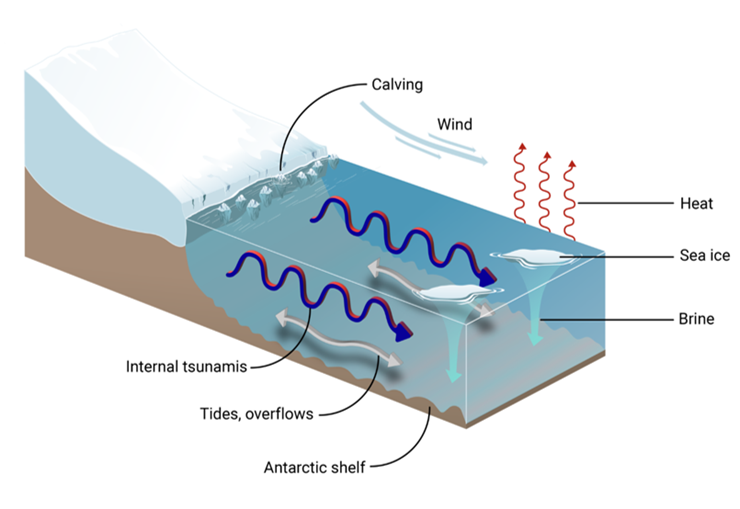
Recent observations led in Borgen Bay on the Western Antarctic Peninsula in 2020 have demonstrated that internal tsunamis play a significant role in vertical mixing, a process previously thought to be driven solely by wind, tides, and buoyancy forces. At the local scale, vertical mixing plays an essential role not only in the transport of salinity and temperature — which directly impact the dynamics of marine-terminating glaciers — but also in the transport of nutrients that contribute to marine ecosystems. At the global scale, this phenomenon also participates in the drawdown of carbon from the atmosphere. However, in the context of global warming, the frequency and intensity of calving events and the resulting internal tsunamis are increasing. It is therefore essential to better understand internal tsunamis generation and propagation in order to assess the future implications of polar regions for supporting ecosystems and regulating the climate.
Measuring internal tsunamis
To this end, the POLOMINTS (POLar Ocean Mixing by INternal TSunamis) project was launched, bringing together scientists from various disciplines to study the generation of internal tsunamis.
The study initially focuses on the Sheldon Glacier, northeast of Ryder Bay on the Western Antarctic Peninsula. To quantify the impact of the generation and propagation of internal tsunamis on vertical mixing and the properties of the water column, part of the team is leading fieldwork at the British Antarctic Survey’s Rothera Research Station for two summer seasons: 2025–2026 and 2026–2027.
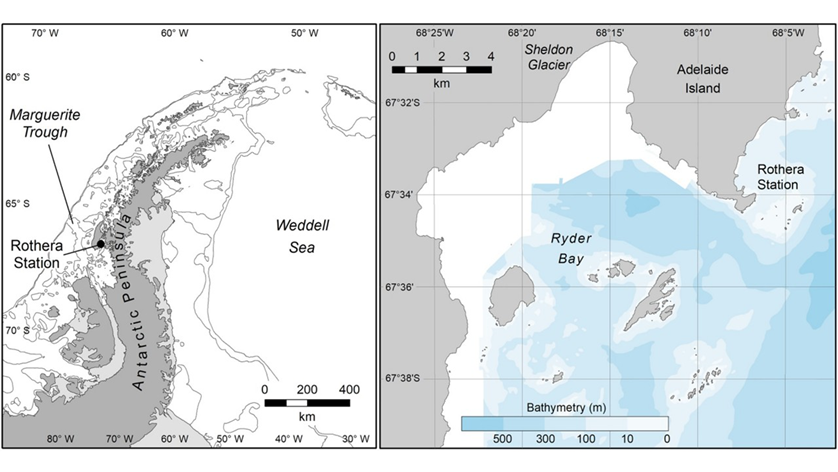
This fieldwork enables both a physical and a biogeochemical approach to the study of internal tsunamis. It is based on a combination of various measurement methods, including Autonomous Underwater Vehicles, seabed-deployed devices (Acoustic Doppler Current Profiler, Bottom Pressure Recorder), airborne campaigns, fixed-camera array recording Sheldon glacier front, small-boat sampling at different distances from the glacier, laboratory analysis of collected water samples, and glacier front mapping from Erebus workboat.
How to get to Antarctica?
The journey to Antarctica begins in London with a long flight to Punta Arenas or to the Falkland Islands. The trip generally involves two or three days of flying before landing in southern Chile. There are then two options for getting to Rothera:
– The Dash plane, which operates during the summer;
– The RRS Sir David Attenborough. In that case, a journey of about five days is necessary to reach Ryder Bay.
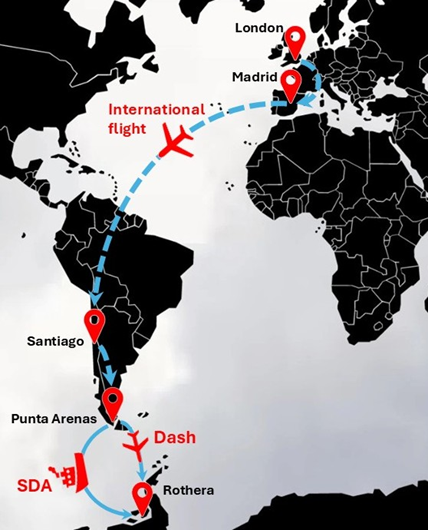
The Antarctic adventure — in pursuit of the internal tsunamis generated by calving events — begins with this long journey, which is followed by a fascinating period of fieldwork, a wonderful opportunity and an exceptional experience!