Ocean dynamics in Antarctica: Zoom on ice-calving induced internal tsunamis
Antarctica — one of the most unique regions in the world, seen by many as a hostile yet fascinating icy environment characterized by endless expanses of ice, glaciers, and mountains, where penguins, seals, orcas, and whales can be found. For scientists, this region is of particular interest. The oceanic dynamics around Antarctica play a key role in global ocean circulation, marine productivity and global climate regulation.
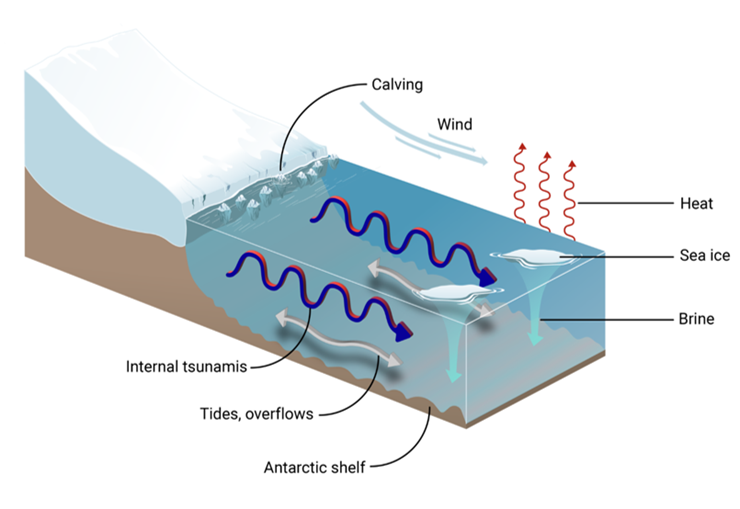
Antarctica is surrounded by numerous glaciers, some of which face the ocean: the marine-terminating glaciers. These glaciers are in constant motion. Ice accumulates along the coast and on the slopes of the mountains before gradually flowing down and extending toward the ocean. These movements, combined with variations in temperature and pressure between the ice, the atmosphere and the water, gradually weaken the glacier’s head, causing a portion of it to break off and form icebergs. The break-off of ice blocks of varying sizes from the glacier, define as calving events, can displace significant amounts of water, resulting in the generation of two waves: a surface tsunami and a deep-water tsunami, known as internal tsunamis
Schematic of ice-calving induced internal tsunamis
Recent observations led in Borgen Bay on the Western Antarctic Peninsula in 2020 have demonstrated that internal tsunamis play a significant role in vertical mixing, a process previously thought to be driven solely by wind, tides, and buoyancy forces. At the local scale, vertical mixing plays an essential role not only in the transport of salinity and temperature — which directly impact the dynamics of marine-terminating glaciers — but also in the transport of nutrients that contribute to marine ecosystems. At the global scale, this phenomenon also participates in the drawdown of carbon from the atmosphere. However, in the context of global warming, the frequency and intensity of calving events and the resulting internal tsunamis are increasing. It is therefore essential to better understand internal tsunamis generation and propagation in order to assess the future implications of polar regions for supporting ecosystems and regulating the climate.
Measuring internal tsunamis
To this end, the POLOMINTS (POLar Ocean Mixing by INternal TSunamis) project was launched, bringing together scientists from various disciplines to study the generation of internal tsunamis.
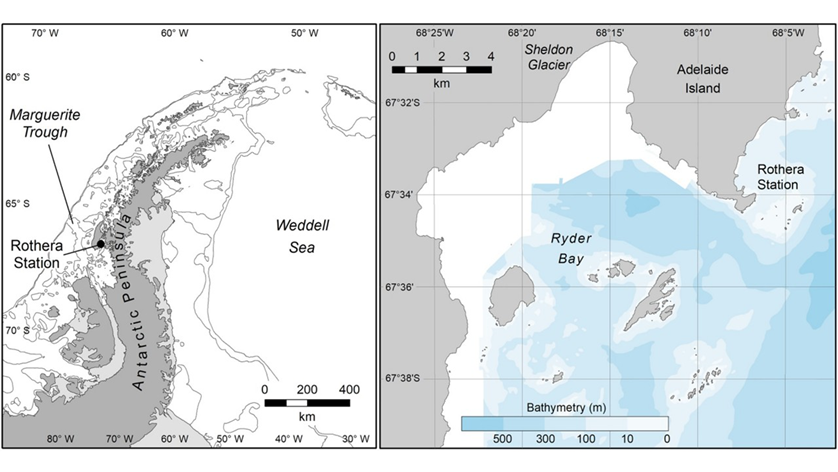
The study initially focuses on the Sheldon Glacier, northeast of Ryder Bay on the Western Antarctic Peninsula. To quantify the impact of the generation and propagation of internal tsunamis on vertical mixing and the properties of the water column, part of the team is leading fieldwork at the British Antarctic Survey’s Rothera Research Station for two summer seasons: 2025–2026 and 2026–2027.
Map of Ryder Bay, on Adelaide Island, Western Antarctic Peninsula (Figure form Inall et al., 2021).
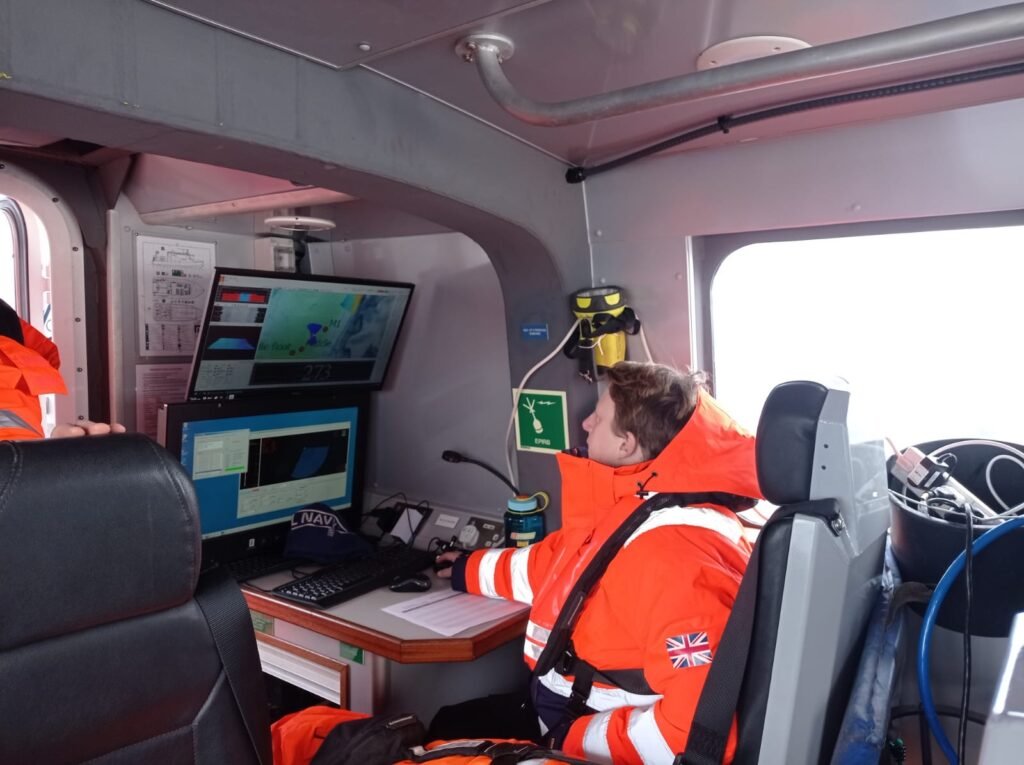
This fieldwork enables both a physical and a biogeochemical approach to the study of internal tsunamis. It is based on a combination of various measurement methods, including Autonomous Underwater Vehicles, seabed-deployed devices (Acoustic Doppler Current Profiler, Bottom Pressure Recorder), airborne campaigns, fixed-camera array recording Sheldon glacier front, small-boat sampling at different distances from the glacier, laboratory analysis of collected water samples, and glacier front mapping from Erebus workboat.
How to get to Antarctica?
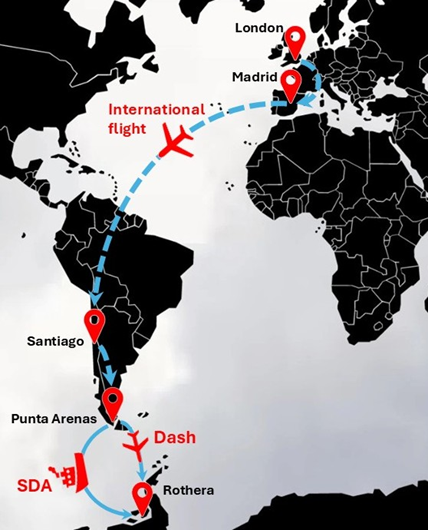
The journey to Antarctica begins in London with a long flight to Punta Arenas or to the Falkland Islands. The trip generally involves two or three days of flying before landing in southern Chile. There are then two options for getting to Rothera: – The Dash plane, which operates during the summer; – The RRS Sir David Attenborough. In that case, a journey of about five days is necessary to reach Ryder Bay.
Map of the travel from London to the Rothera Research Station
The Antarctic adventure — in pursuit of the internal tsunamis generated by calving events — begins with this long journey, which is followed by a fascinating period of fieldwork, a wonderful opportunity and an exceptional experience!
A robot is cruising beneath Antarctic sea-ice. Another is bolted to the face of a collapsing Greenland glacier. A third is silently counting penguins on a remote, windswept beach. None of them has a human operator nearby.
“It’s really cool to be able to whip out my phone here in Cambridge and send commands to a glider that’s doing stuff thousands of miles away in the Antarctic.”
Dr Alex Brearley is an oceanographer at the British Antarctic Survey (BAS). He’s one of the growing number of scientists who’re using autonomous vehicles to investigate Earth’s rapidly changing polar environments.
Underwater, on the surface and in the air – robots of all shapes and sizes are now gathering information on a scale and with a precision that previous generations of researchers could only dream about.
Alex could be there in person in the Antarctic – but doesn’t have to be. Commands are uploaded via the internet and when the robots make the connection, they go about their business.
Alex has several gliders on the go at any one time. They’re equipped with a range of sensors to tell him about the ocean’s properties and how it’s behaving.
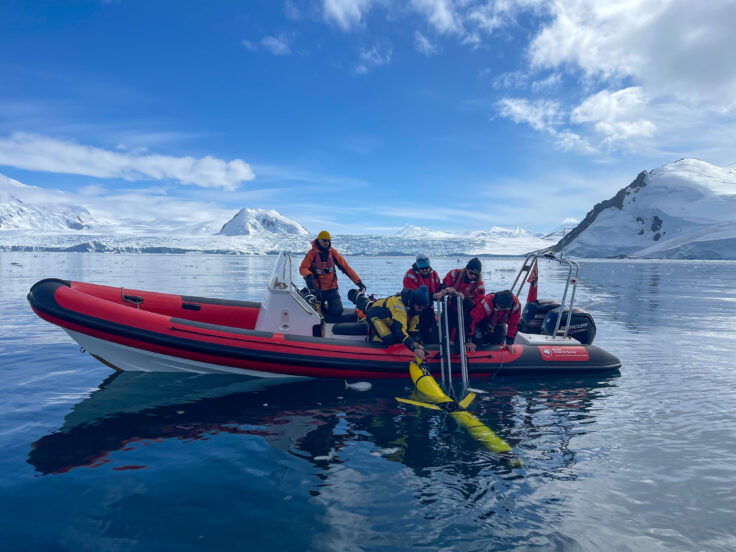
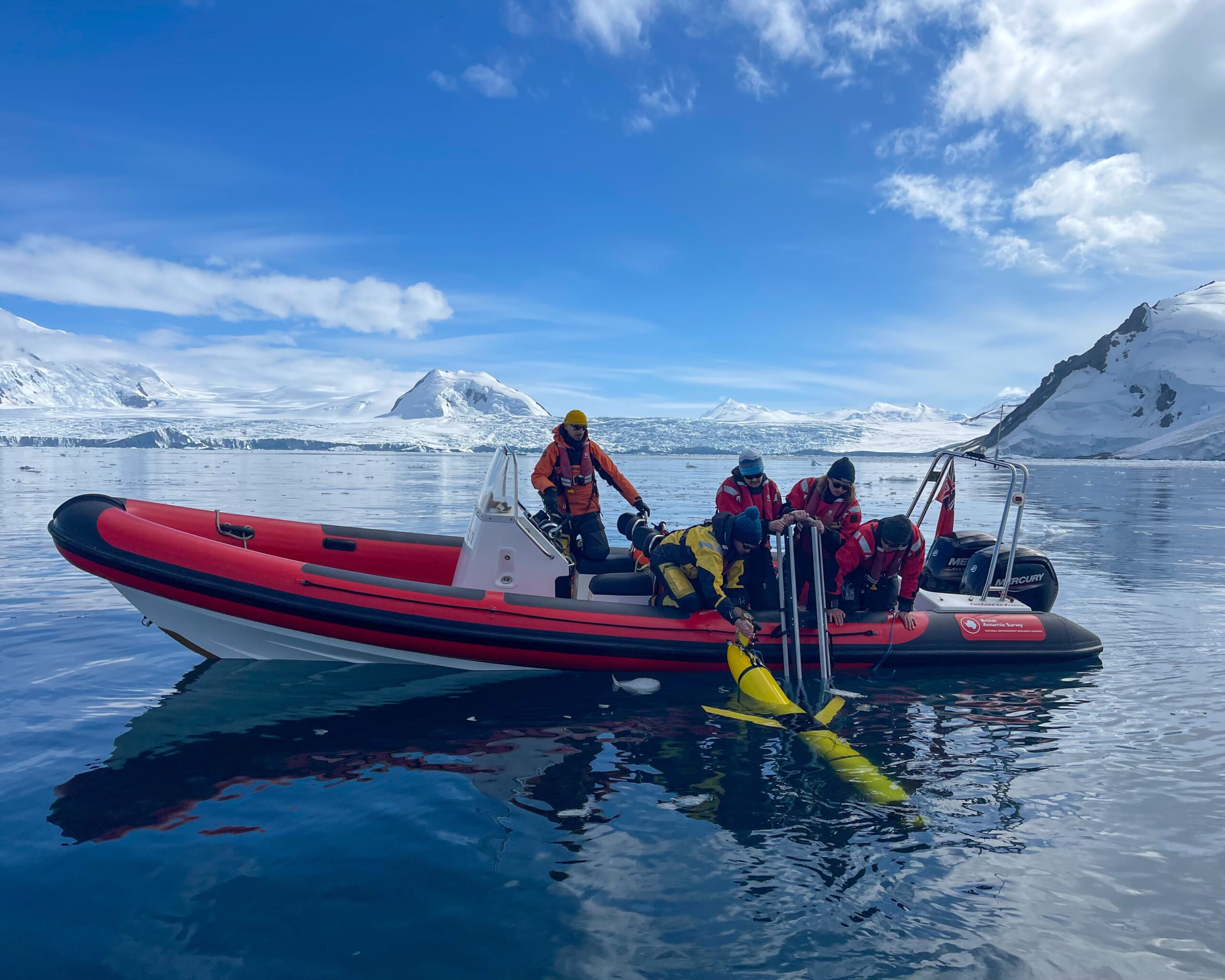
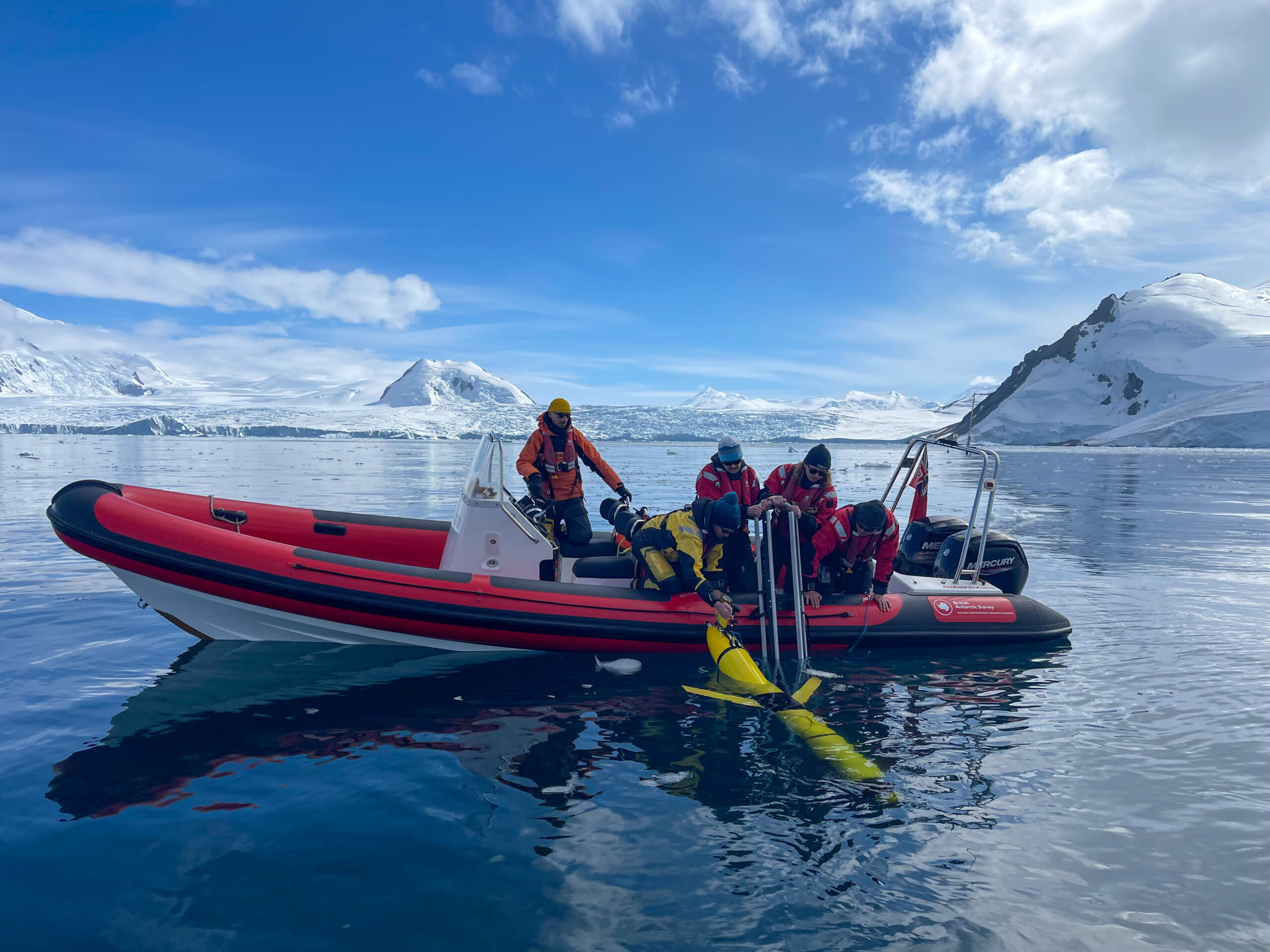
Deployment of a Slocum Glider nearby Sheldon Glacier in Antarctica (Credit: Athena Dinar).
His sleek machines resemble torpedoes and move through the ocean with remarkable efficiency. An oil-filled bladder alters their buoyancy, making them sink and rise, while a moveable battery pack changes the centre of mass to pitch the nose either up or down. A set of small wings then converts that vertical motion into a slow forward glide through the water column. No engine. No propeller. Just physics.
Periodic visits to the surface enable positioning fixes via GPS and an opportunity to beam back data to Cambridge, as well as picking up new commands. Careful power management means you can run a glider for months on end.
Alex currently has a glider fleet patrolling Ryder Bay, just off Rothera Research Station on the Antarctic Peninsula. The gliders are fitted with sensors to monitor how the waters in the bay are being stirred up as glacier ice calves and crashes into the sea. It’s a spectacular process that sends powerful waves sweeping through the water column to mix heat and nutrients, while also pushing carbon down to depth.
This phenomenon of “internal tsunamis”, as they’re called, was first spotted from a crewed ship. The gliders have now taken over the follow-up research as part of the “Polar Ocean Mixing by Internal Tsunamis (POLOMINTS)” project – which makes more sense both economically and scientifically.
“The gliders come in later as the way to observe the same kinds of processes but in much higher resolution,” Alex says. “It’s often about having the longevity of the missions that a ship can’t do without spending vast amounts of money.”
In other words, the ship discovers the signal and the gliders then unpack it.
The big adoption of autonomous vehicles has been driven in large part by a technological convergence, where miniaturised sensors have been integrated into increasingly capable robotic platforms. Many of the same innovations built into our smartphones are also transforming the tools scientists use in the field.
And you don’t need to be a specialist engineer to deploy an autonomous vehicle.
Professor Mark Inall from the Scottish Association for Marine Science (SAMS) was an early adopter of the technologies.
“When I first started with autonomous underwater vehicles (AUVs) it was very, very technical and challenging – you had to spend weeks training just to begin to understand how to run the thing. Now you can pick one up, have a day or two’s training, put it in the water and run it yourself. The barrier to entry has come right down. Yes, it needs to come down a bit further, but we’re already at the stage where non‑specialists can operate these vehicles.”
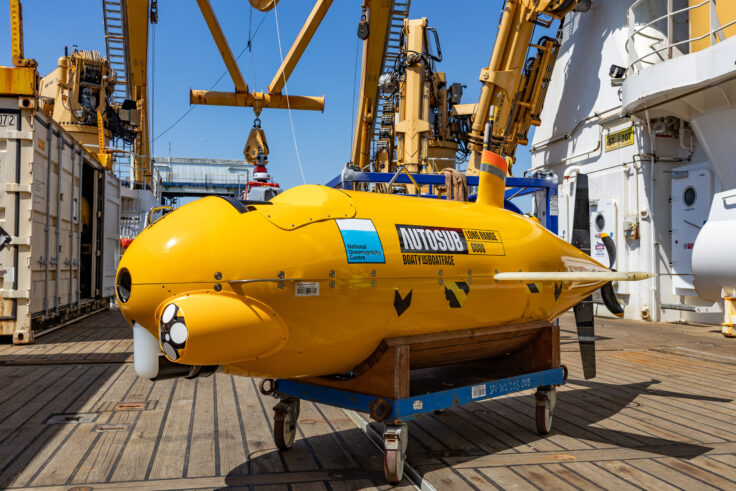
The scope of what’s possible is perhaps best illustrated by what BAS is doing right now in the Arctic. The GIANT (Greenland Ice sheet to AtlaNtic Tipping points) project is in the process of deploying an extraordinary array of vehicles to investigate how exactly Greenland’s fjord glaciers melt when they encounter warm ocean water. Nine different systems are working together on the problem, including the famous chubby yellow submersible known as Boaty McBoatface.
Autosub Long Range, Boaty McBoatface, on the deck of the RRS Sir David Attenborough (Credit: Tom Acton).
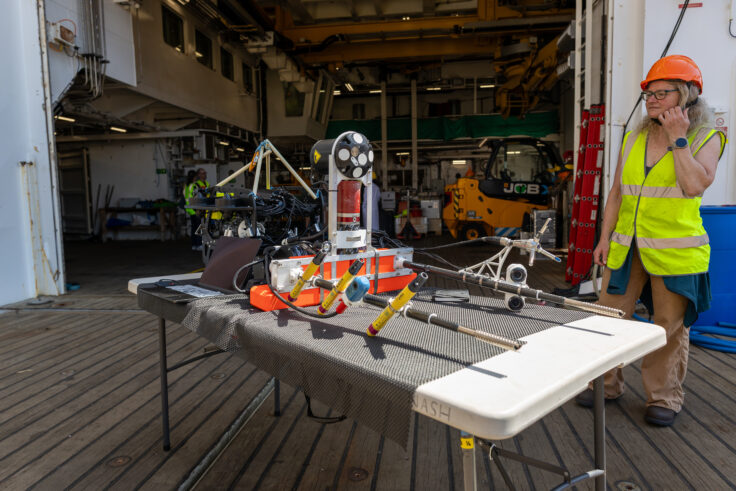
One of the more unusual GIANT vehicles is called Meltstake. It can take measurements in a location no human scientist would dare put themselves – right up against the vertical cliff face of a crumbling glacier. Who wants to risk thousands of tonnes of ice falling on their head?
Meltstake is essentially an automated drilling platform festooned with sensors. It’s delivered to the front of the glacier by a self-driving boat. That’s the easy part. The Meltstake still has to get to the real point of interest… 100m to 200m below the waterline. So, it piggybacks to depth on a remotely operated diving vehicle.
On arrival, the Meltstake then screws itself into the wall, and continues screwing as the ice face melts to keep up with its retreat. Included in the sensor package are cameras, hydrophones to “listen” to the ice, and acoustic scanners to map the ocean currents – the energy that shapes the evolving glacier face.
This persistent, close-up presence of Meltstake against the glacier face allows its operators from Oregon State University to explore a massive gap in climate science, where current computer models appear to underestimate glacier melt – likely because they are not properly representing important details of the melting process.
Oregon colleague Professor Erin Pettit says their previous work on Alaskan fjord glaciers suggests the ice itself is an active participant in its own destruction.
“It’s packed with tiny, pressurised bubbles that hiss and burst as they are released into the water. When the bubbles pop out, they disturb the boundary layer of the fluid,” Erin explains. “This creates a chaotic churn that generates more of that energy that then feeds back to melt the ice even faster.”
No human scientist could have got that close. That’s rather the point.
Professor Erin Pettit with Meltstake on board the RRS Sir David Attenborough (Credit: Tom Acton).
While some robots can be bolted directly into the path of potential destruction, others are designed to solve a different problem entirely: simply being in the right place at the right time.
For Dr Norman Ratcliffe, a seabird biologist at BAS, this means deploying a remote “drone in a box” system on Signy Island, part of the South Orkney archipelago.
The territory hosts a summer-only research station. That is, scientists are present only in the southern summer, which means they miss the chance to observe the early breeding activity of Adélie penguins. But Norman’s drone is on station to catch the birds’ entire reproductive cycle.
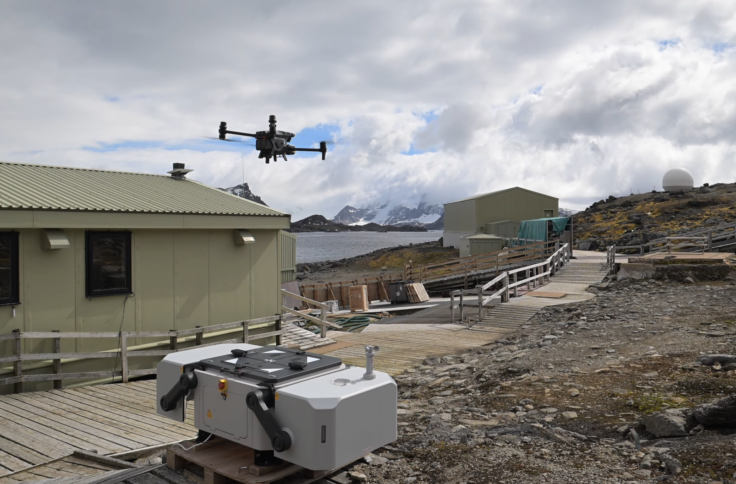
The drone lives in a powered docking hangar. This both charges the robot and protects it from the foulest weather. Aerial surveys to count bird nests and assess the population are commanded from Cambridge HQ, again via the internet.
The pre-programmed reconnaissance flights are impressive to watch. The drone will fly up a hill, following the contours perfectly to produce a map in which the ground sampling distance is exactly the same throughout the entire survey.
“If we can pilot things safely from Cambridge, that allows us to do surveys almost any time of year, irrespective of the staffing we have on station,” Norman says. “In terms of doing repetitive survey tasks, it’s just an incredibly efficient way to do it, particularly if you’re short of people or trained pilots.”
The trials last summer were a huge success, and the aspiration is to have the drone in place year-round. Norman would also like to use long-distance drones to extend surveys to the west of the archipelago. It’s where large colonies of penguins haven’t been observed in detail for decades. Drone work could help address questions about how breeding success is being affected by the fishing industry’s nearby pursuit of krill, the tiny crustaceans that form a key food source for the birds.
The ‘drone-in-a-box’ system operating on Signy Island.
Norman would no doubt find an ally in BAS biological oceanographer Dr Sophie Fielding. She’s been observing krill in waters off the island of South Georgia, using a 2m-long autonomous surface vessel called Sailbuoy.
Think “miniature yacht” and you’ll get the look of the vehicle immediately – a sail, hull, and keel. The only driven element is the rudder, which shifts position to guide the vessel as it tacks across the wind. Power for the onboard electronics comes from deck-mounted solar panels feeding a couple of laptop-style lithium batteries.
Sophie’s Sailbuoy is equipped with an echosounder to detect the presence and abundance of krill to a depth of 300m to 400m. The data comes back via satellite.
One of the big attractions of Sailbuoy is its ability to stay out at sea gathering data for months on end – beyond the time available to a large, in-demand research ship. And, importantly for BAS, which is committed to reducing its environmental footprint – Sailbuoy is a an exceptionally low-carbon way of collecting data.
“For low-complexity platforms like Sailbuoy you’d probably want to deploy swarms of them – swarms of Sailbuoys chasing swarms of krill,” Sophie says.
Fixed-wing aerial drones are also becoming a staple of polar research, and the eBee X is one such vehicle that’s making a great contribution.
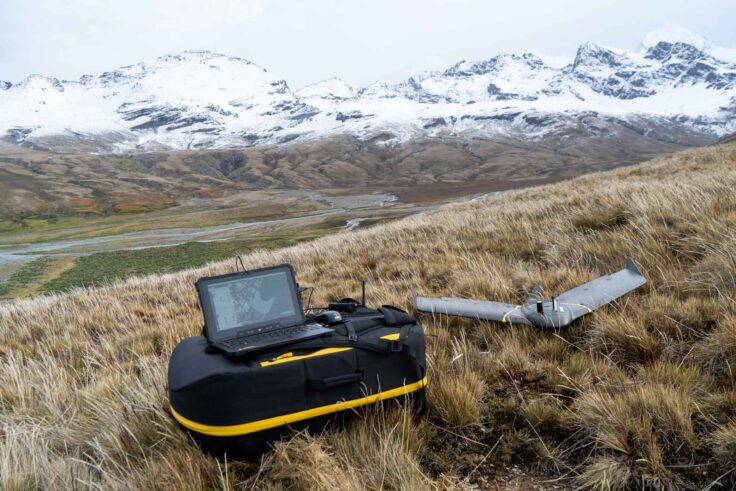
About 1.2m wingtip to wingtip, the black, propeller-driven drone weighs just 1.6kg – light enough for our scientists to carry it into the field in a backpack.
It’s made largely from polystyrene with a carbon-fibre base plate to protect the battery, electronics and sensor system.
And eBee X is super-easy to use. It’s hand-launched, fully autonomous and will stay aloft for about 90 minutes. Recovery is a simple, soft “crash” landing.
The eBee X drone being used in the field in South Georgia (Credit: Nathan Fenney).
The vehicle has proved hugely valuable in the globally renowned wildlife haven of South Georgia, where the authorities running the British Overseas Territory understand its reliability and are comfortable with it being flown beyond the line of sight of our researchers. That approval has enabled eBee X to make long, sweeping photographic sorties along beaches, updating the status of animal populations, some of which due to their remote location have rarely been visited and are poorly understood.
Nathan Fenney heads geomatics and led the introduction of the eBee X at BAS.
“Traditionally small drone operations have typically been conducted within what’s called ‘visual line of sight’ (VLOS), which requires the drone to stay within around 500 m of the pilot during the flight. By being able to operate ‘beyond visual line of sight’ (BVLOS) with platforms like the eBee X, we are able to survey significantly larger areas, potentially over several kilometres, and survey targets not otherwise accessible overland, leaving us best placed to capture both South Georgia’s largest and more remote wildlife colonies.”
Using the data collected by the eBee X, the team has developed a new counting methodology which uses the digital elevation model (3D model of the surface), produced using photogrammetry to count the animals, rather than the imagery . This underpinned the first full, direct tally of king penguins at one of the birds’ hotspots at St Andrews Bay, confirming a massive increase in breeding pairs, now numbering more than 132,000. Ironically, the increase is probably the result of rapid glacier retreat making more space on the beaches for the penguins to nest.
eBee X surveys also revealed a sharp, post-bird-flu collapse in southern elephant seals at three key South Georgia colonies. It was estimated that island-wide, over 50,000 females could have failed to arrive for the annual breeding season.
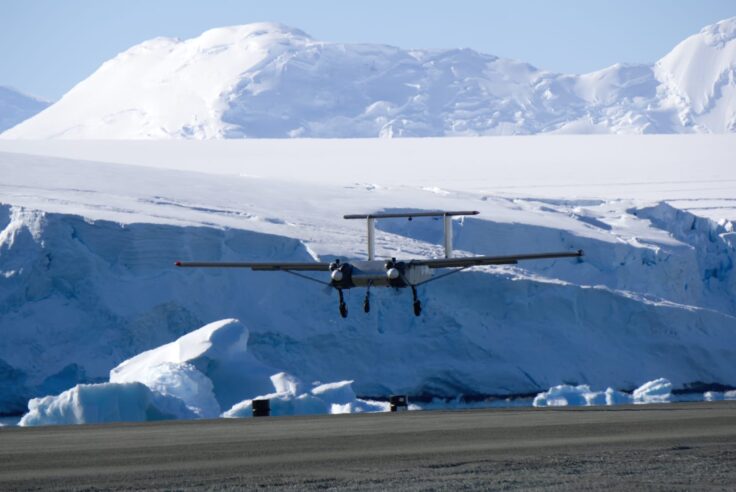
When it comes to fixed-wing drones, the Windracer ULTRA is in a different league. It’s 10m wingtip to wingtip and can easily carry 50-60kg of payload. It will fly on its own, beyond the horizon, for up to 1,000km.
For geologist Dr Tom Jordan, it means his investigations into the deep rock structures under Antarctica’s ice sheet are entering a new era.
In the past, his survey work required the heft of a crewed Twin Otter plane – a long-time workhorse in the polar south. Picture Tom sitting in the back of one of these planes, monitoring his instruments – radars, magnetometers, gravimeters, and the like. Now, he can stay on the ground, while the Windracer completes the flight plan autonomously.
“For years the instruments were too heavy and the drones too small. Now the lines have crossed – the sensors are light enough and the drones are capable enough that using them for serious Antarctic science finally makes sense,” Tom explains. “By moving our surveys on to drones, we can do the same science with a fraction of the fuel and logistics. Instead of needing 200 drums of fuel for a big aircraft, we might get away with 20 for a Windracer. Using a drone for survey also frees up our Twin Otter aircraft for other critical work supporting field teams, or surveying with larger sensors, making the best use of all our assets.”
Tom used Windracer recently to gather new insights into the geological history of the Antarctic Peninsula. This “finger” of land that stretches north from the white continent towards South America was formed by a string of volcanoes whose underlying pools of magma turned to solid rock. Windracer was able to map the massive “roots” of two of those ancient volcanoes that formed up to 50 million years ago.
The Windracers ULTRA UAV lands at Rothera Research Station during test flights (Credit Carl Robinson).
Yet, even as all of this activity grows, the consensus among BAS scientists is that autonomous vehicles are a supplement to human presence. They’re not a replacement.
For one thing, regulations are still trying to catch up with the reality of all the uncrewed traffic. Tom Jordan will tell you about the pain of getting permits to fly large drones in what seem to be the emptiest spaces on Earth. It can be a time-consuming interaction with authorities that aren’t yet resourced to deal with all the requests they receive.
Likewise, Sophie Fielding can describe her back-and-forth with marine agencies who – understandably – want reassurance that her mini science yacht won’t collide with a ship and damage its propeller.
But the tide is coming in, and fast.
BAS Director of Science, Professor Petra Heil, frames autonomous platforms as the missing middle layer in polar science – the nimble go-betweens that fill the gap between satellites staring down from space and the scientists braced on the decks of big ships or standing on the ice.
And she’s clear that artificial intelligence will be riding the wave, orchestrating this tiered approach to observing:
“AI can show us where our science is blind. It can pull together satellites, models and past measurements to highlight the hotspots of uncertainty. You need AI to manage the data, to target where you send the platforms, and to keep reshaping the missions as the environment and the technology change.”
But perhaps Norman Ratcliffe puts it best. For all the technological wizardry, there are still some things that only a human scientist with muddy knees can do:
“There’s no drone I know of that can catch, weigh and put a tag on a penguin; or collect their poo to look at what they’ve been eating.”
Kate Retallick, from Bangor University, spoke about POLOMINTS on BBC Radio Wales on 4th June 2026.
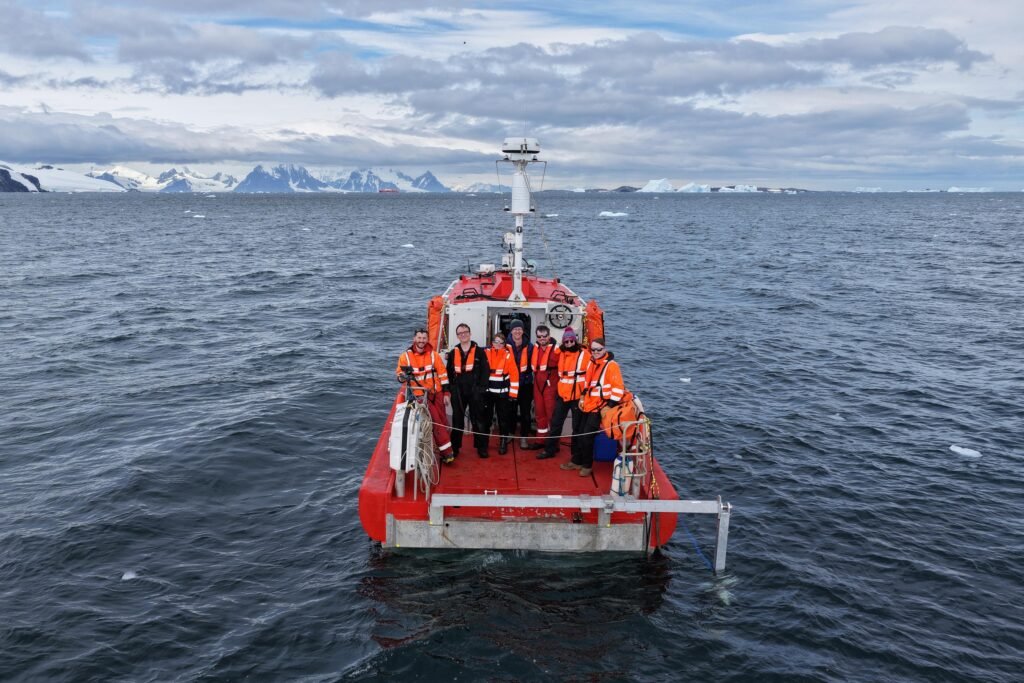
Kate and the rest of the crew on Erebus. (Credit: Kate Retallick)
In the segment (which can be found here, after the 1h55 mark) Kate talked about the POLOMINTS general research aims and how they used Bangor University’s multibeam echosounder mounted to Erebus to create the first 3D underwater profiles of the glacier margin in Sheldon Cove. She explained how this would be combined with oceanographic measurements and observations from stereo cameras to better assess the impacts of calving and generation of internal tsunamis in the fjord. Kate also spoke about the positive aspects of working in Antarctica, getting to continue the exploration of one of the remotest places on Earth, having been inspired to contribute in research there since childhood, plus amazing scenery and wildlife; and the not so good bits, i.e. having to spend a lot of time away from family.
Originally posted on the BAS websiteon 28th May 2026
British Antarctic Survey scientists and support staff are coming to the end of another successful Antarctic science season. As austral winter begins to set in, RRS Sir David Attenboroughhas completed a round of final calls to Rothera, King Edward Point and Bird Island Research Stations, leaving smaller wintering teams to continue research and operations.
The BAS field season (September 2025 to May 2026) saw 688 people working at various locations across the continent, including polar scientists, technicians and support staff. More than 50 science projects took place across land, ice and sea – covering topics from weather and climate to wildlife and ecosystems – as they worked to deepen our understanding of the polar regions and their wider impact on the planet.
“This season, our teams stepped up their work across Antarctica to understand this fragile system in transition. New methods were trialled, and field measurements were fused with autonomous technology, helping us to capture near-real time insight – from marine logistics to species management.”
Rothera Research Station
It’s been a season of change at Rothera Research Station on the Antarctic Peninsula. Older buildings have been removed, and the new Discovery Building is now fully operational, giving us a modern and more efficient hub for our polar science.
One of the major science projects was the NERC-funded POLOMINTS, operating out of Rothera to reach nearby Sheldon Glacier. Scientists studied underwater tsunamis caused by glaciers breaking off into the ocean, to see how this effects heat and nutrient cycling in the water. Using echo sounders and underwater gliders, they collected 3D images of glacier fronts and a wealth of other data to track changes above and below the water’s surface – helping to improve climate models.
The POLOMINTS team deploy an underwater glider at the Sheldon Glacier (Credit: Athena Dinar).
Long-term monitoring also continued at Rothera, expanding on a dataset running for over 25 years. Known as Rothera Time Series (RaTS), it involves water samples, ice observations, a monthly diving programme, and much more. The data acts as a baseline for the region, telling us what’s changed over recent decades and helping predict the impacts of a changing climate.
Halley VI Research Station
Meanwhile, at Halley VI Research Station on the floating Brunt Ice Shelf, the key focus was keeping the station operational for ongoing ice shelf, atmospheric, and space weather projects. It is home to equipment that gathers data autonomously for these projects year-round.
Addressing the challenges of this remote location were another key part of the season’s work. The team returned to Halley to find deep snow, and raised the whole station on its hydraulic legs twice during the season to avoid being buried. The team also navigated the exchange of cargo with the ice-capable cargo ship, the Silver Mary, from the Brunt’s ice cliff – an effort which represented the first year of our new shared logistics partnership with the Norwegian and German polar programmes.
Bird Island Research Station
Just off the northwest tip of South Georgia, scientists at Bird Island Research Station have been adding to their long-term monitoring dataset for marine predators. This includes population and breeding monitoring for species such as albatrosses, giant petrels, macaroni penguins, as well as Antarctic fur and leopard seals.
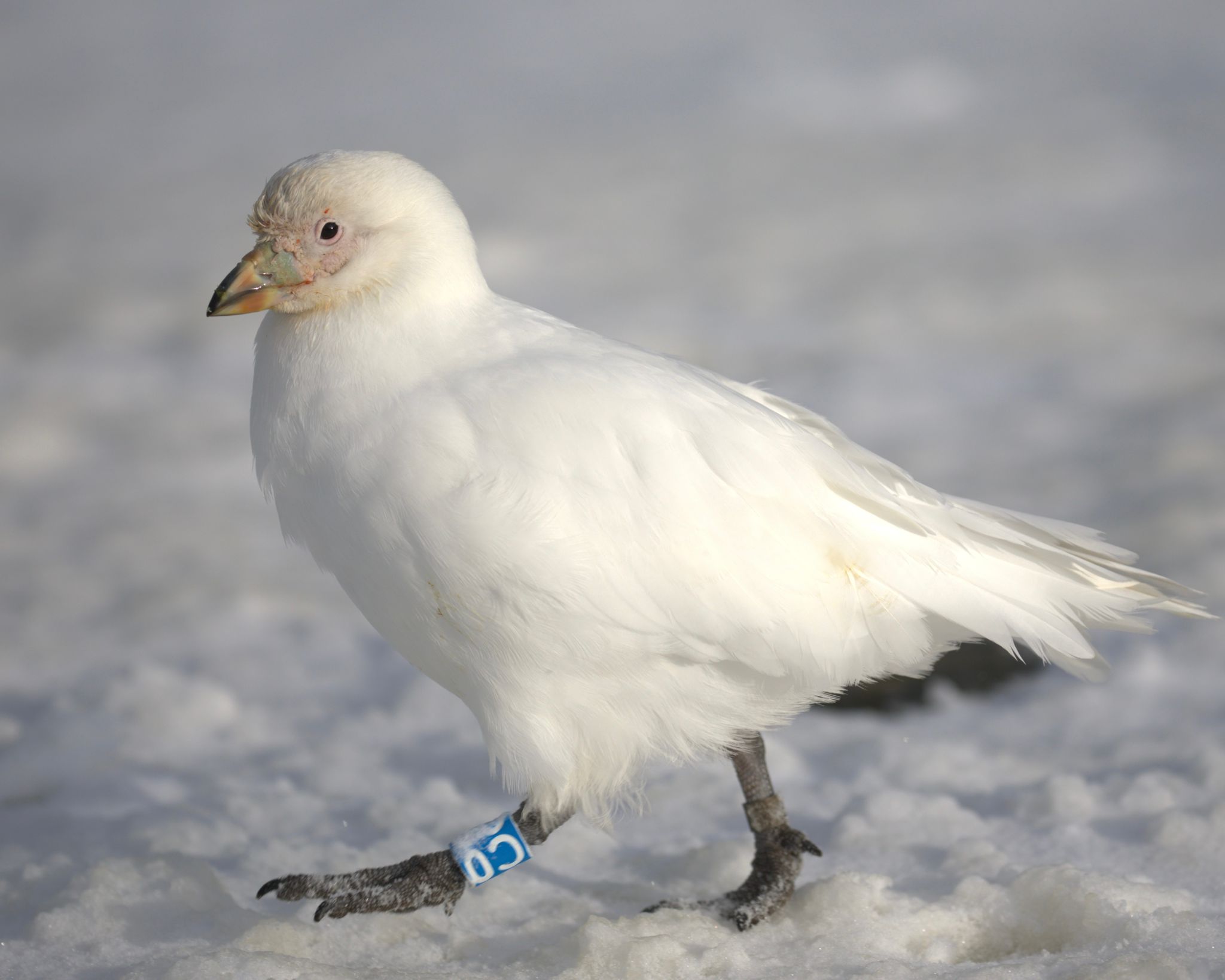
The species that has taken the spotlight this year is the snowy sheathbill – as little is known about their population size, migratory movements, or behaviours. Scientists on the island have now tagged over 400 of the birds. Re-sightings of these tags allow the scientists to build up a picture of how many sheathbills there are, and where they go. The birds are already revealing themselves to be willing travellers, with some tagged birds seen at other locations around South Georgia.
Snowy sheathbill with one of the scientific tags on its leg (Credit: Ashley Bennison).
King Edward Point Research Station
Further east on South Georgia lies King Edward Point (KEP) Research Station. The team at KEP have been monitoring populations of whales, seals, and penguins. This will help to guide management of fisheries and boating traffic to minimise their impact on wildlife. They’ve also gathered important data about avian influenza, including how it spreads between and impacts seals and seabird populations.
A highlight at KEP this season was the ECHO survey. This is a big project that aims to understand how wildlife interacts, and how environmental change can ripple through these wildlife populations. This is done by taking lots of ecosystem measurements at the same time, including acoustic surveys and net sampling for krill, plankton sampling, and observations of penguin, seal, and whale movements.
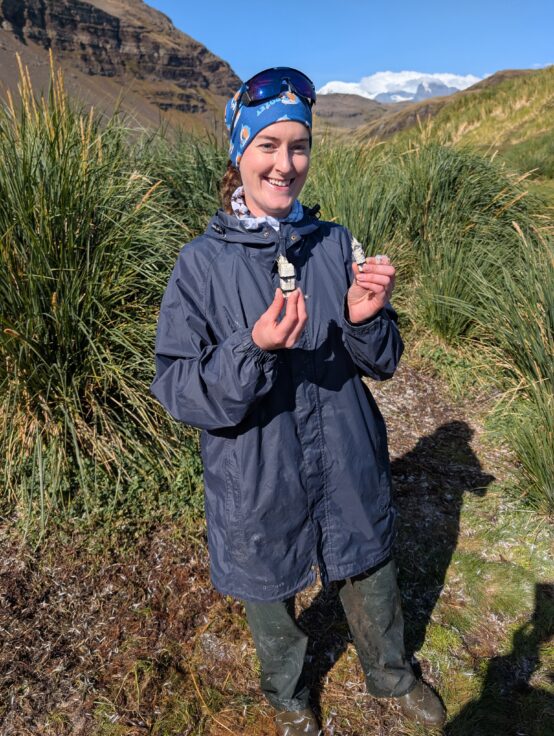
The Synchronised Swimming project formed a big part of this. Scientists attached GPS tags to penguins and used the GPS data in combination with the acoustic surveys to detect how the penguins interacted with krill swarms. Their data suggests the penguins are foraging in the same areas where the surveys detected krill, which is vital data to support the management of the marine protected area around the island.
Camille De Pasquale holding two penguin-tagging devices in the field near King Edward Point Research Station (Credit: Jaimie Cleeland).
A mass washup of dead bivalves were also found on a beach close to KEP – with their shells a muted pink colour instead of their usual green. The team delivered a rapid science response, collecting samples to find out what happened, and what it indicates about the health of the Southern Ocean.
Signy Research Station
On the remote South Orkney Islands, science projects at Signy Research Station have involved monitoring marine predators, collecting bivalve samples, and investigating how the island’s vegetation is responding to a changing climate.
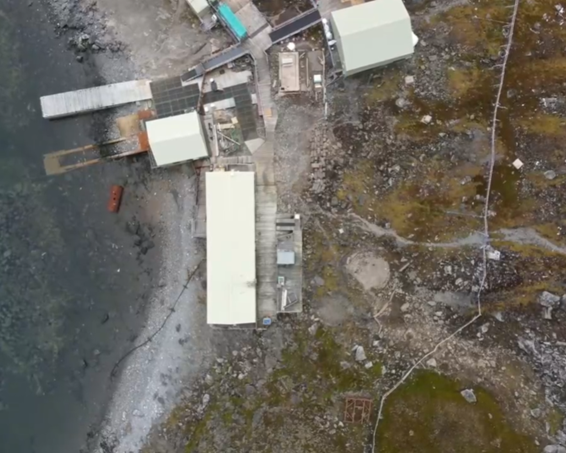
Scientists have also explored using a new state-of-the-art drone, which can take aerial surveys of the island while piloted by scientists in Cambridge in the UK. So far, the drone has created a useful 3D map of the island and conducted important surveys of wildlife populations. Scientists are hoping to use the drone in seasons to come to conduct surveys that wouldn’t have been possible before – such as monitoring early-nesting penguin species whose breeding begins before scientists return to the station in spring.
An aerial view of Signy Research Station from the DJI Dock I drone.
In the field
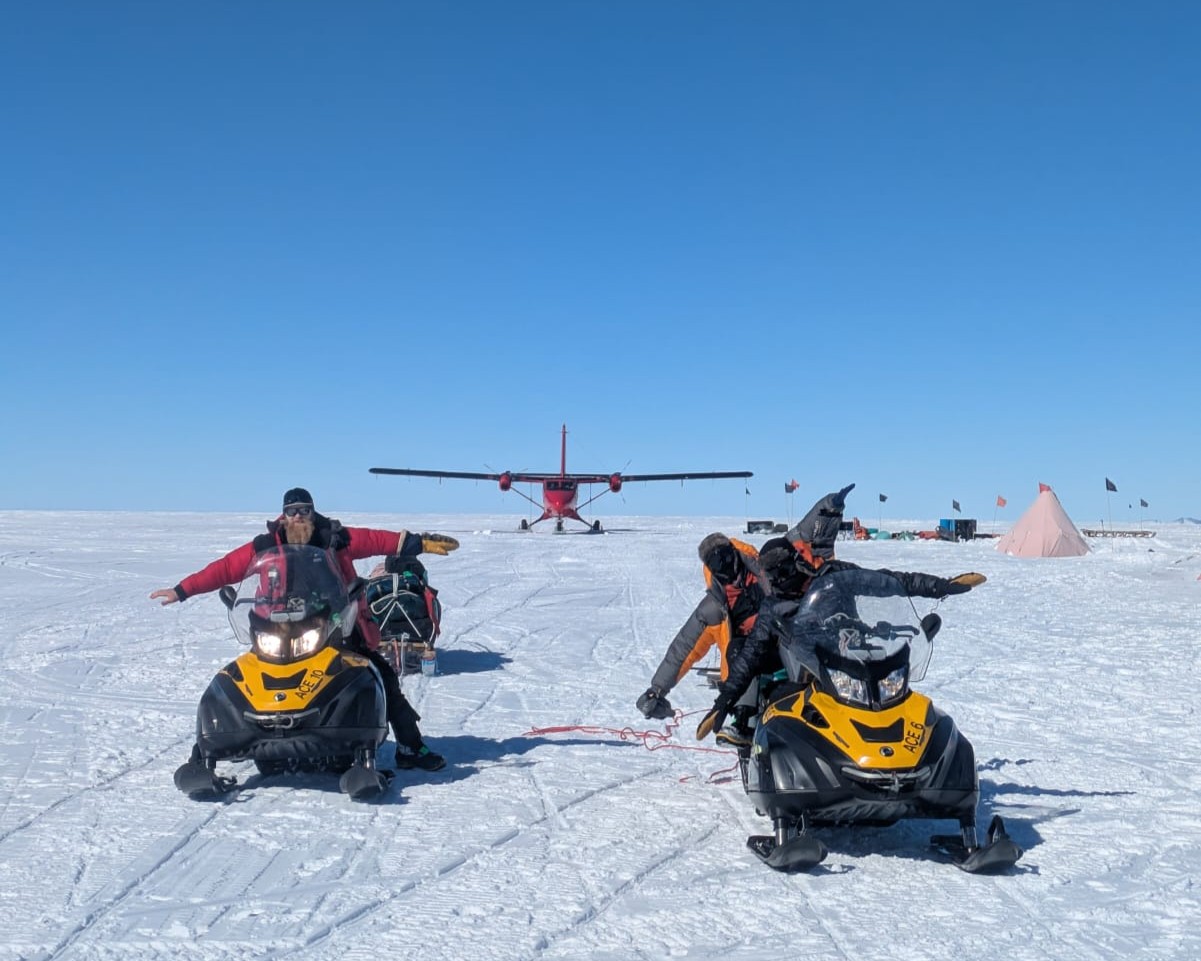
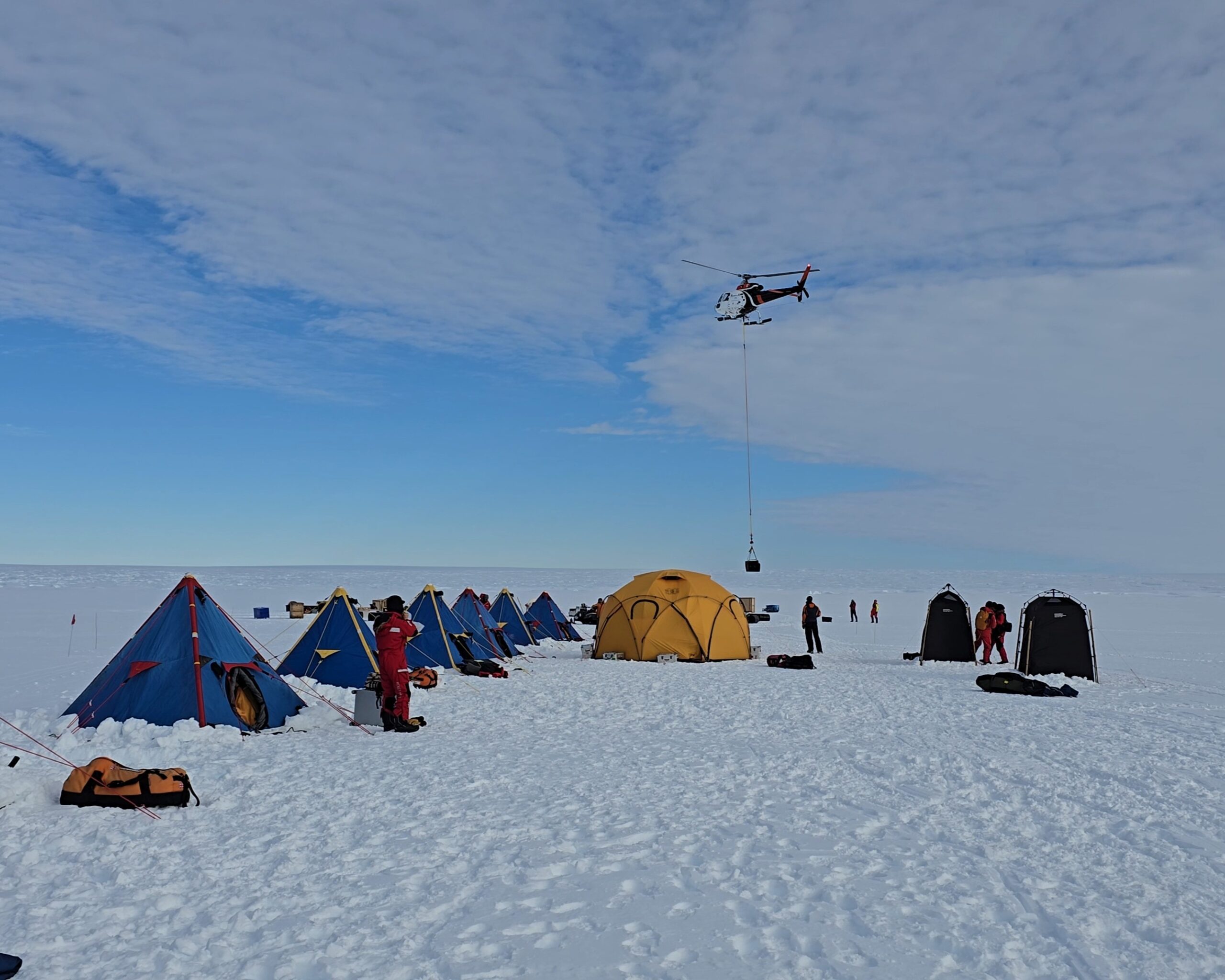
At a remote base camp 35km from Sky-Blu, the REWIND ice core drilling project aimed to collect samples from the last 10,000 years to see how winds and sea ice have influenced the uptake or release of carbon from the Southern Ocean. After digging out the previous season’s equipment, the team successfully drilled a 271-metre ice core, containing an estimated 1,000 years of climate data – the oldest ice core ever drilled in this part of the Antarctic Peninsula. Unfortunately, a broken drill part cut the work short. The data gathered will help us better predict whether the Southern Ocean is likely to absorb or release carbon in the future.
The ReWIND Team at the ice core drilling site near Sky Blu (Credit: Charlotte Phillips).
Scientists from BAS and the Korea Polar Research Institute (KOPRI) travelled to the unstable and rapidly-changing Thwaites Glacier in West Antarctica. The aim was to understand how ocean processes and seawater temperatures beneath the ice are driving melting, with potential for major sea level rise. BAS provided world-leading hot water drilling expertise, reaching over 1,000 metres through the ice to gather the first ever oceanographic data from beneath the glacier’s main trunk. This revealed turbulent and relatively warm waters melting the ice from below. However, plans to deploy instruments for long-term monitoring were foiled as the rapidly-moving glacier trapped the equipment within the ice. Regardless, the data gathered will be invaluable for understanding ocean-ice interactions at Thwaites.
The hot water drilling camp on top of Thwaites glacier (Credit: Peter Davis).
At Snow Hill on the Antarctic Peninsula, drone counts and tagging of emperor penguins supplemented wider monitoring of emperor penguin populations using satellite imagery. These data revealed dramatic sea ice changes and fewer groups of moulting emperor penguins. This has prompted the species to be classified as endangered by the IUCN Red List of Threatened Species.
At sea
It’s been a busy season on the polar research vessel, the RRS Sir David Attenborough (SDA). In December & January, the SDA was equipped with specialist sensors to assess the performance of its propellors and icebreaking capabilities in specific types of sea ice. It is hoped the results will enable future operations in conditions previously considered too challenging, and improve maritime safety in polar conditions.
Among the major science commitments of the season were the long-term monitoring of zooplankton and tracking of biogeochemical processes near South Georgia. This includes chemical sampling for important nutrients, krill sampling, and measurement of carbon flux, which will improve our understanding of ocean ecosystems and their role in climate regulation. These are some of the longest running polar marine datasets, which support the UK’s ‘national capability’ – they feed directly into area conservation plans and international policymaking forums like the international Commission for the Conservation of Antarctic Marine Living Resources (CCAMLR) within the Antarctic Treaty System.
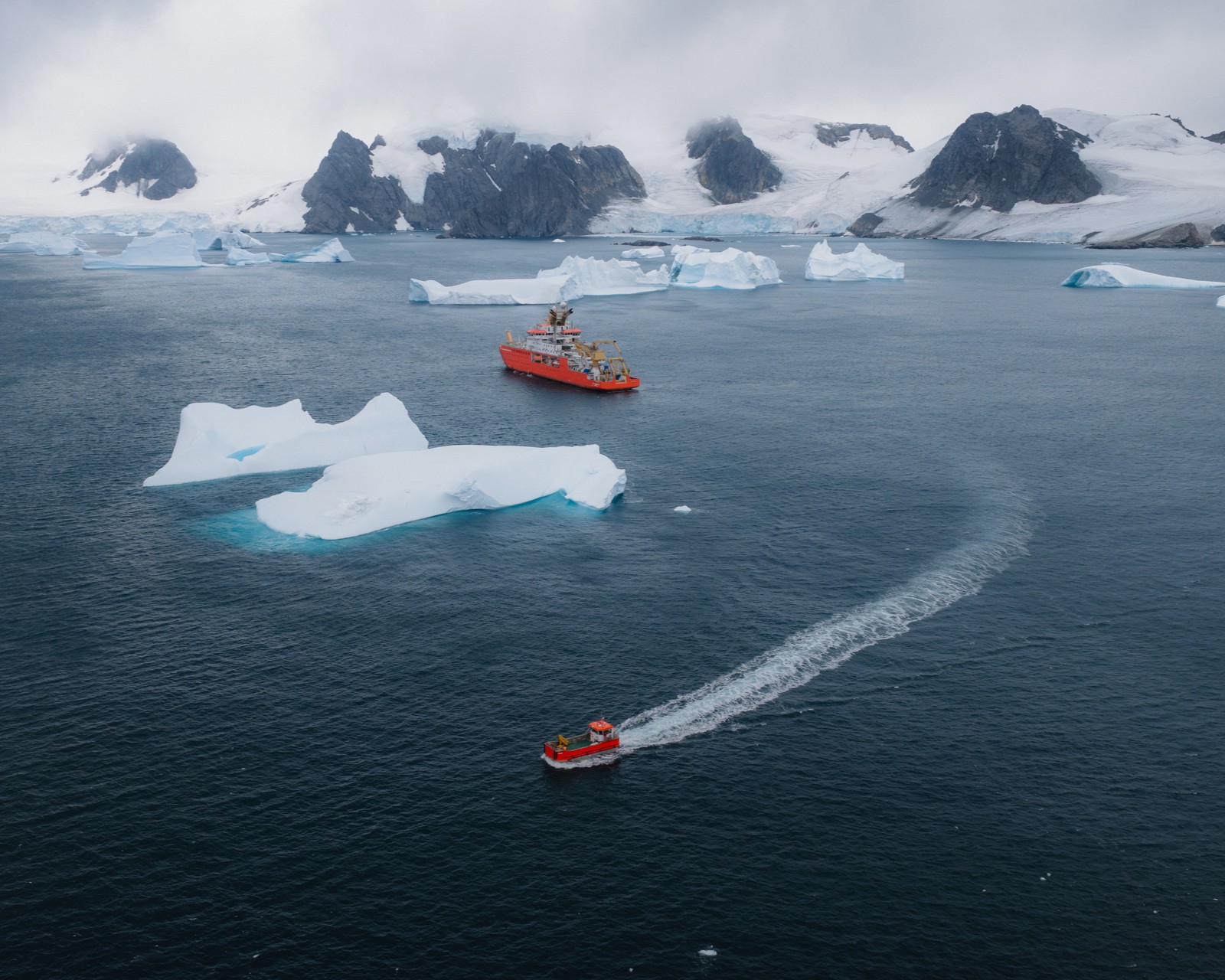
The RRS Sir David Attenborough and the workboat, Terror, operating in the Southern Ocean (Credit: Joe Jackson).
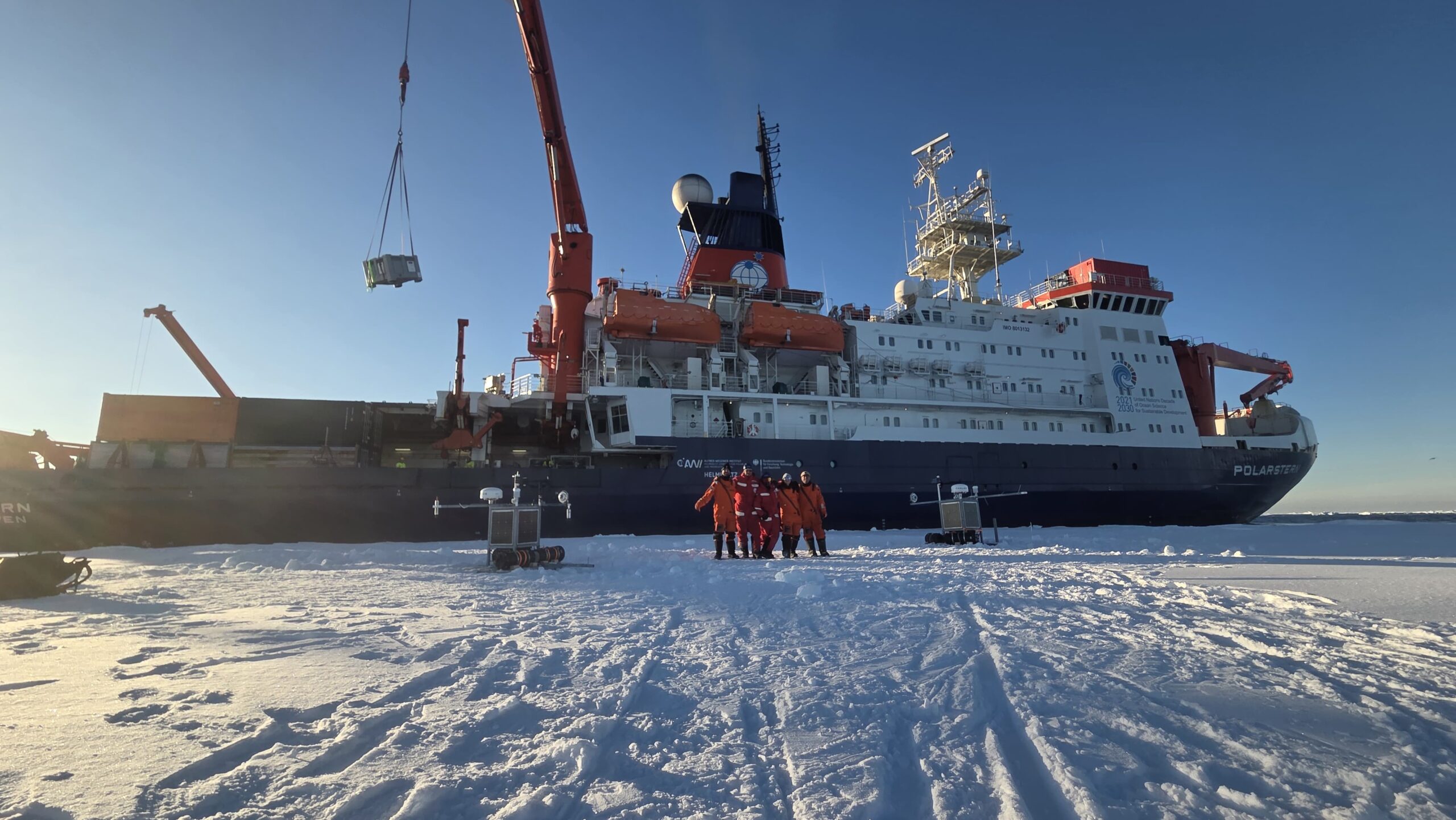
BAS scientists have also been busy in the Weddell Sea aboard multiple voyages on the German research ship, the RV Polarstern. With the help of autonomous sea ice buoys, autonomous submarines and specialized atmosphere and aerosol sensors, they took a range of measurements from sea ice properties, marine biodiversity and atmospheric composition. Despite rough seas and 41m/s winds, the team gathered some vital data – data that will be critical for understanding changing Antarctic sea ice, the marine biodiversity it supports, ocean-ice-atmosphere interactions and Southern Ocean cloud processes.
Scientists in front of the RV Polarstern (Credit: A Medic, Alfred Wegener Institute, The University of Rostock).
A season to celebrate
With staff now returning home, the work is far from over. Samples and data collected throughout the season will feed into research efforts around the world, deepening our understanding of polar science and its role in our changing climate.
“I’d like to offer a profound thank you to the dedicated teams who worked on the ice, at sea, and elsewhere across BAS,” says Petra. “The data you gathered this season will help decision-makers respond to the planet’s changing climate and ecosystems, and work towards a secure future for us all.”
As is tradition, staff across the whole of BAS are now gearing up to celebrate midwinter’s day when it arrives on 21 June – from those on the SDA and overwintering at stations, to staff at our Cambridge sites and elsewhere in the world. The Antarctic Research Trends Report 2025 recently acknowledged BAS as the most productive and highest impact single polar institute in the world: something that is certainly worth celebrating.
An international team of researchers, led by British Antarctic Survey (BAS), is setting out to discover how glacier calving around Antarctica can trigger powerful underwater tsunamis.
When icebergs break off glacier fronts and fall into the ocean (a process called calving) they can create powerful underwater tsunamis. These hidden waves, often several metres in height, cause powerful bursts of ocean mixing, where different layers of water get churned together. This process strongly mixes heat, oxygen and nutrients between different depths, and is critical for marine life and climate regulation in the region.
This mixing was previously thought to be primarily driven by wind, tides and heat loss at the ocean surface. However, initial calculations suggest underwater tsunamis play a significant role in polar oceans, rivalling the effect of wind-driven mixing in certain locations, and having a bigger impact than tides in redistributing heat in the ocean.
This newly discovered phenomenon was observed by chance when researchers aboard BAS’ previous research ship, RRS James Clark Ross, collected ocean data before, during and after a calving event during an expedition to Antarctica. Now, scientists are at Rothera Research Station, on the Antarctic Peninsula, and on board the UK’s polar research ship RRS Sir David Attenboroughto learn more about underwater tsunamis.
“We want to learn what creates underwater tsunamis, how they work, and what impact they have – do different types of calving cause differences in the tsunami? Do the different conditions in each season change how the tsunamis form? What does the mixing that they cause do to the polar climate and ecosystems?”
Using satellites, remote cameras, drones and underwater robots, the team will collect data from glacier fronts, including locations too dangerous for researchers to go. They will develop and apply deep-learning algorithms to analyse satellite data, and computer simulations to model how these tsunamis are generated and spread. From this, the researchers will assess the impacts of these intense bursts of mixing on ocean temperature, nutrients and marine productivity – all of which are critical to our climate and ecosystems.
View over Sheldon Glacier. Credit: BAS
Dr Alexander Brearley is an oceanographer at BAS who studies ocean mixing. He is currently at Rothera Research Station using an autonomous underwater vehicle to study the front of the nearby Sheldon Glacier. He said:
“Our team is deploying a range of cutting-edge air, land-based and ocean technology to understand individual glacier calving events at unprecedented resolution and detail, and the impact the tsunamis that are generated have on the ocean. This includes high-quality imagery of the front of the glacier in real-time, ocean moorings with instruments to study the individual waves generated by calving, and underwater autonomous vehicles to document the physical and biological impacts of these underwater tsunamis.”
Underwater tsunamis, and the resulting mixing, could have significant implications for the Southern Ocean and beyond. Increased ocean mixing could draw more warm water up from the deeper parts of the ocean, speeding up the melting of the Antarctic Ice Sheet which would raise sea levels around the world. It can also change how nutrients are distributed in the ocean, which would affect the growth of phytoplankton (the “grass of the sea”), with consequences for the rest of the ocean food chain.
“Antarctica remains one of the most mysterious places on Earth, and we’re constantly discovering previously unknown processes that are shaping our planet. What makes this research so important is that everything in Antarctica is connected – ice, ocean and atmosphere – and those connections reach all the way back to our doorsteps. Rising sea levels, shifting weather patterns, these are Antarctic processes playing out in our lives.”
A key question going forward is understanding whether the current warming climate might increase how often these calving and tsunami events occur, and how strong they are. By learning more about this phenomenon, scientists will refine the ocean models that predict how climate will change in the future.
The POLOMINTS project is a collaboration led by British Antarctic Survey, and includes the Scottish Association for Marine Science, the University of Southampton, the University of Leeds, the National Oceanography Centre, the University of Exeter, and Bangor University. International partners are from the Scripps Institution of Oceanography (USA), the Institute of Geophysics of the Polish Academy of Sciences (Poland), the University of Delaware, and Tufts University (both USA).
POLOMINTS is funded by the Natural Environment Research Council (nerc.ac.uk)
Professor Mike Meredith is an oceanographer at British Antarctic Survey. He concludes a first of its kind science cruise on the RRS Sir David Attenborough conducting research in the polar winter.
Winter in Antarctica is typically the preserve of the few hardy souls who “winter over” at the research stations scattered across the icy continent. But this year, I’ve had the extraordinary privilege of spending time in the Southern Ocean aboard the RRS Sir David Attenborough during the Antarctic winter – a rare opportunity that has yielded some fascinating scientific insights.
Antarctica may seem remote, but its influence stretches across our entire planet. The melt from its vast ice sheet contributes to rising sea levels globally. Changes in ocean circulation and sea ice affect climate patterns worldwide. Even shifts in the Southern Ocean’s chemistry and biology ripple through ecosystems thousands of miles away. While we’ve established these connections scientifically, we still need to understand the detailed mechanisms controlling these processes and how they might change in future. This knowledge is crucial if we’re to take meaningful action now to minimise negative impacts and prepare for inevitable changes.
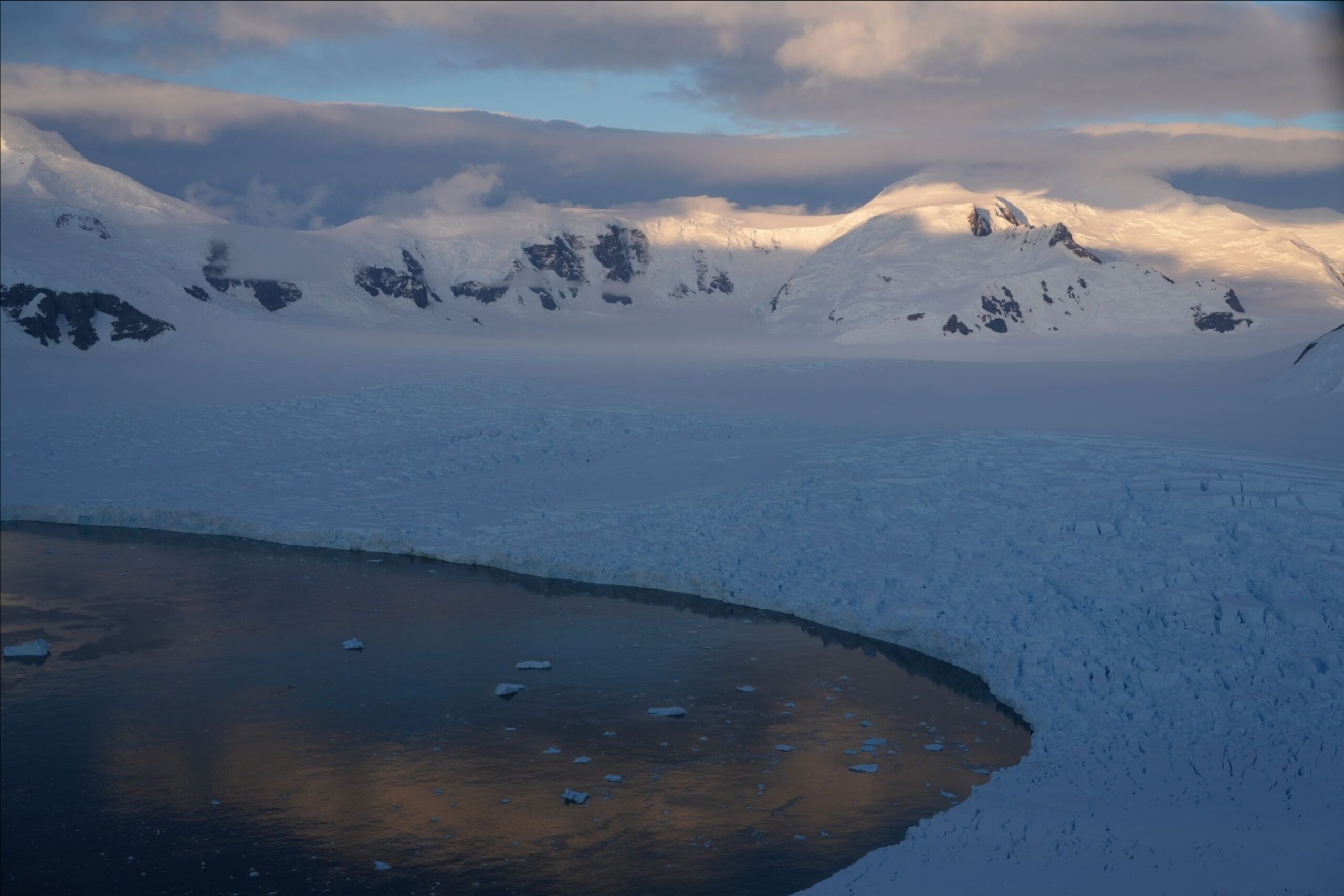
Surveying the edge of the William Glacier in Börgen Bay, Antarctic Peninsula. Photo credit: Mike Meredith.
Most Antarctic expeditions happen during the austral summer when conditions are relatively forgiving – warmer temperatures, minimal sea ice, and those famous endless daylight hours. But some critical processes function very differently during winter months. Glacier melting patterns change, nutrient delivery to the ocean shifts, and the growth of plankton – the foundation of the marine food web – follows different rhythms. Gathering winter data is challenging when you’re facing hostile weather, extensive sea ice, and perpetual darkness, which makes our expedition particularly valuable.
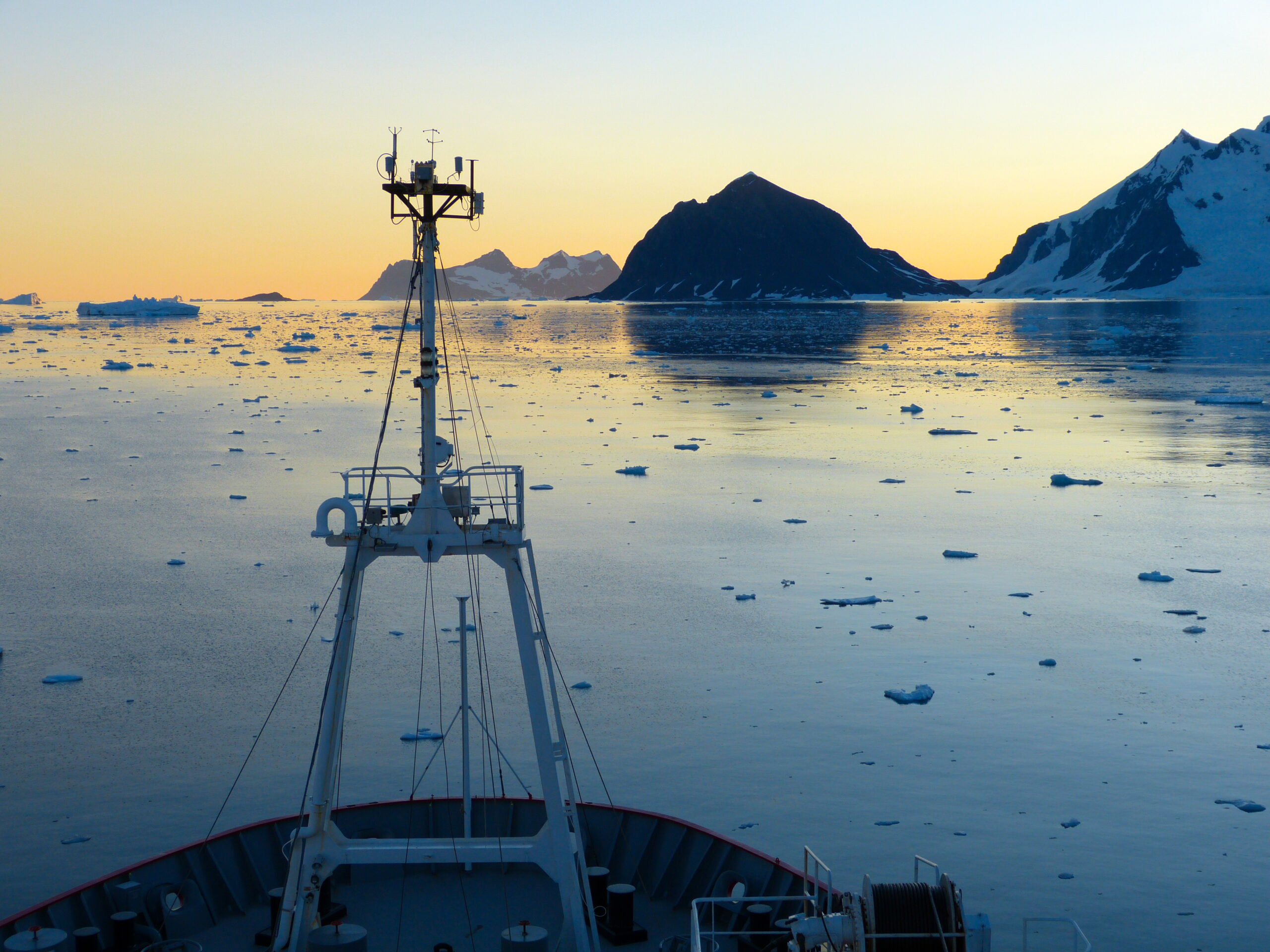
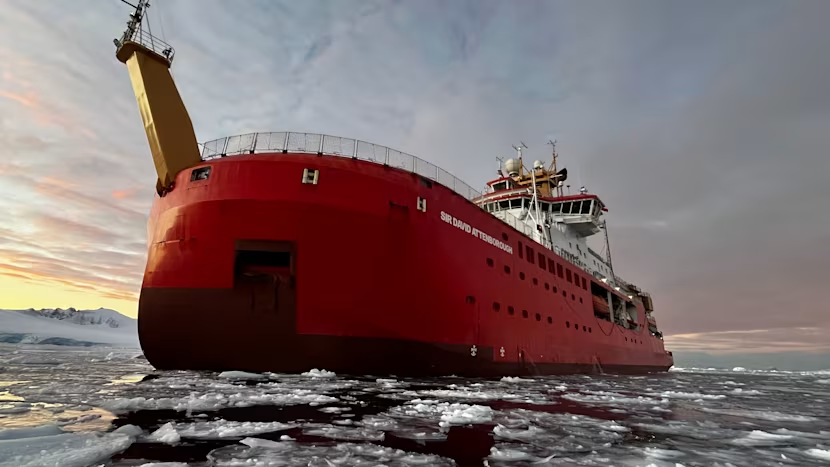
RRS Sir David Attenborough in the Antarctic winter. Photo credit: Lewis Bumstead.
Even in these early stages of analysis, our winter expedition has revealed some intriguing findings. We’ve mapped the seabed near important glacial systems with greater precision, improved our understanding of how ocean processes drive wintertime glacier melting, and begun exploring how these glacial systems might actually help fuel marine life. There’s still extensive work ahead to fully analyse everything we’ve collected, but the value of conducting these rare winter expeditions is already crystal clear.
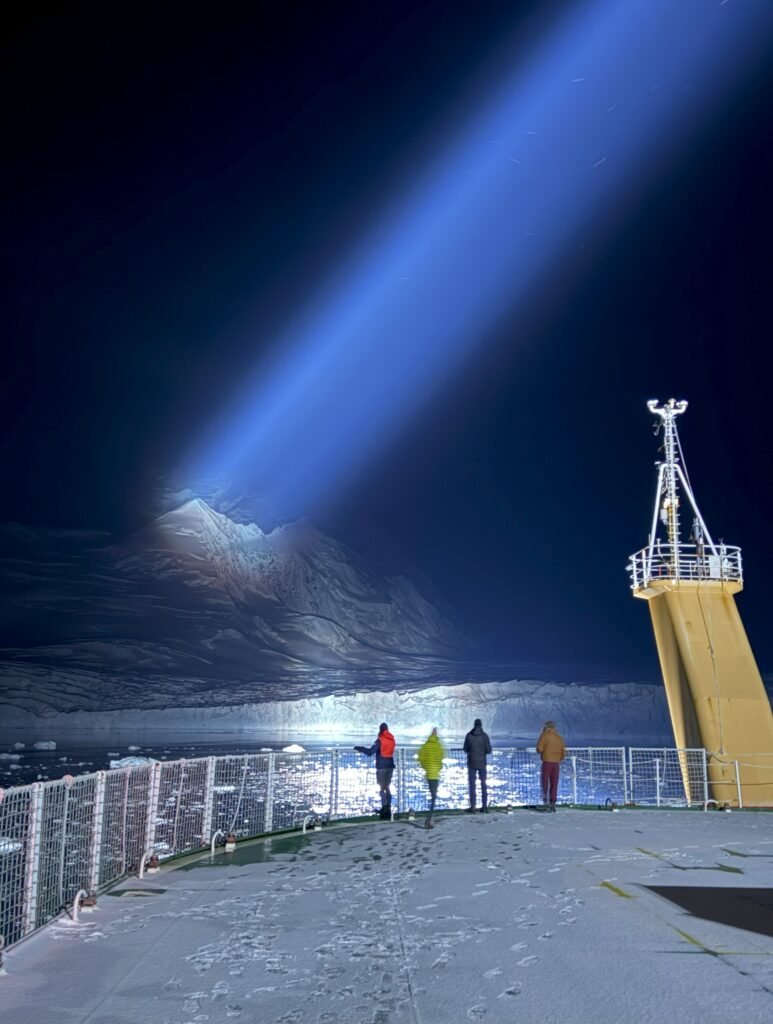
Hostile conditions in winter include perpetual darkness, sea ice, icebergs and blizzards. Sometimes we encountered all at once. Photo credit: Mike Meredith
Beyond the science, being here has been an extraordinary personal experience. The brief winter days create extended twilight periods where sunrise and sunset blend together, painting the ice and ocean in spectacular colours. On clear nights, the dark skies reveal stunning views of stars and the Milky Way, unimpeded by light pollution. We’ve witnessed glaciers calving icebergs right before our eyes – a powerful reminder of the dynamic nature of this seemingly frozen landscape.
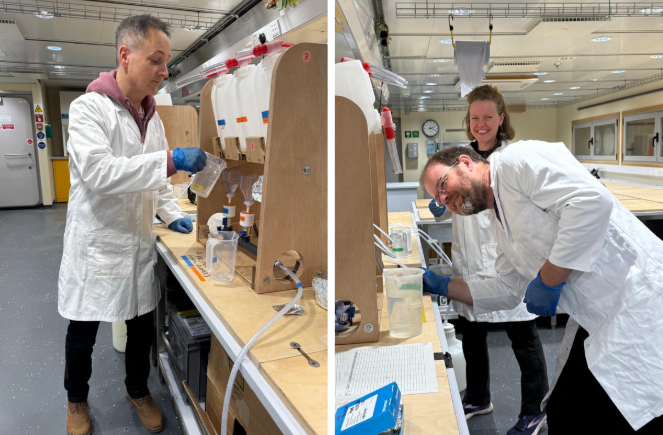
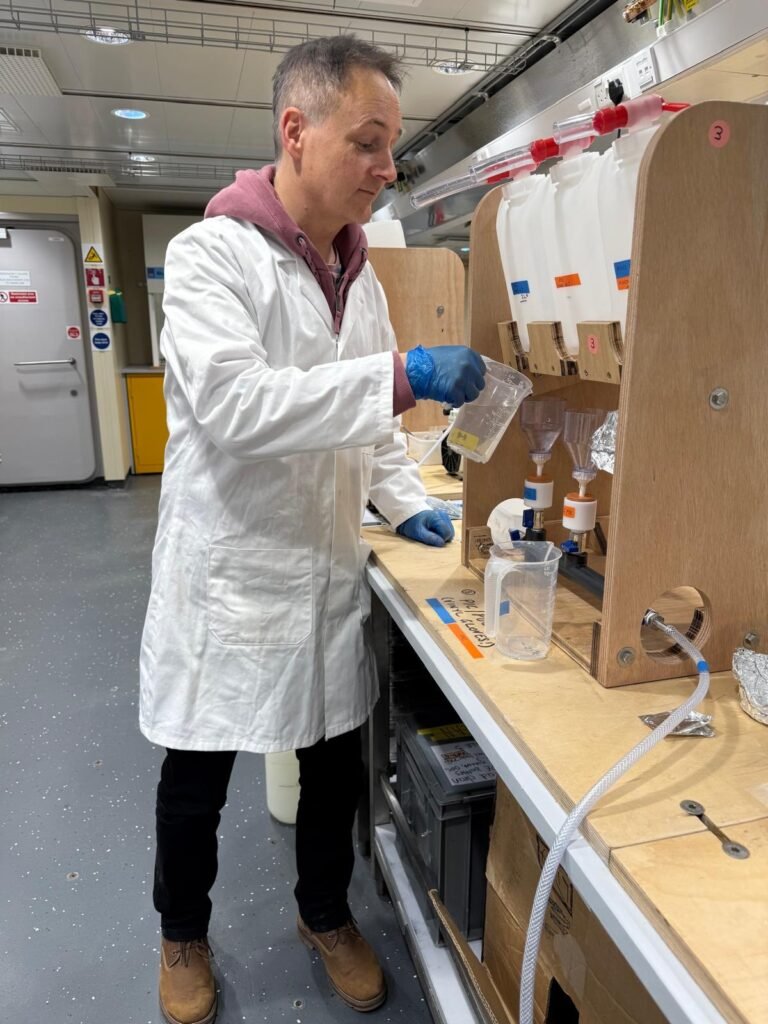
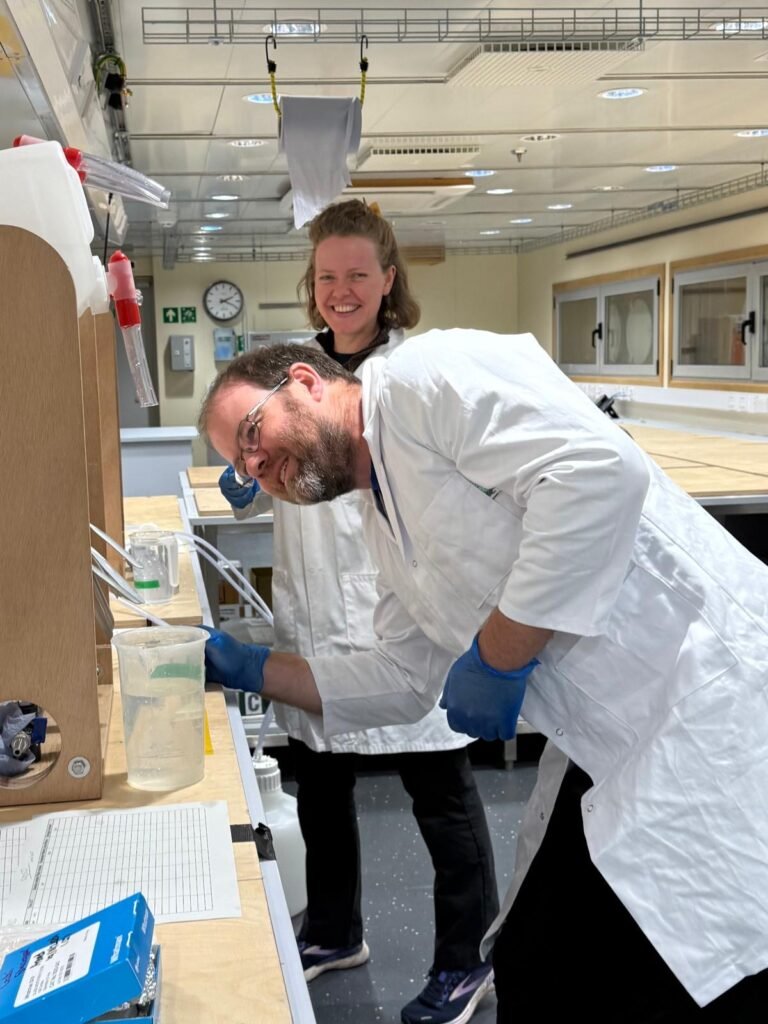
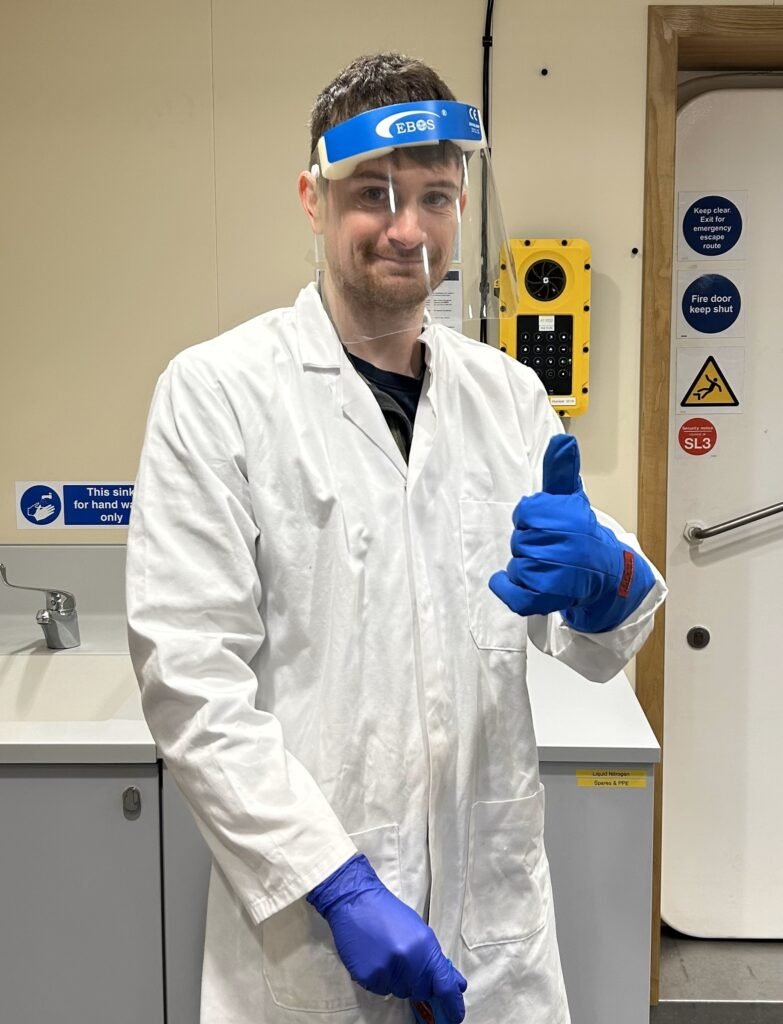
Mike, Hugh and Rhiannon at work in the labs on board the RRS Sir David Attenborough. Photo credit: BAS
I was surprised by how much wildlife we encountered, possibly due to this winter’s unusually light sea ice cover. During just one day of our southbound journey, we spotted over a hundred humpback whales. We’ve also had frequent visits from inquisitive seals, coming to investigate our scientific equipment in the water. Their company was particularly welcome during the long, dark winter nights!
New Bransfield House at Rothera Research Station. Photo credit: BAS
This winter research expedition to Antarctica has been both scientifically valuable and personally transformative. We’re returning home not just with new scientific knowledge, but with a deeper appreciation for this remarkable place – a frozen wilderness that, despite its remoteness, connects to all our lives through its profound influence on our shared planet.
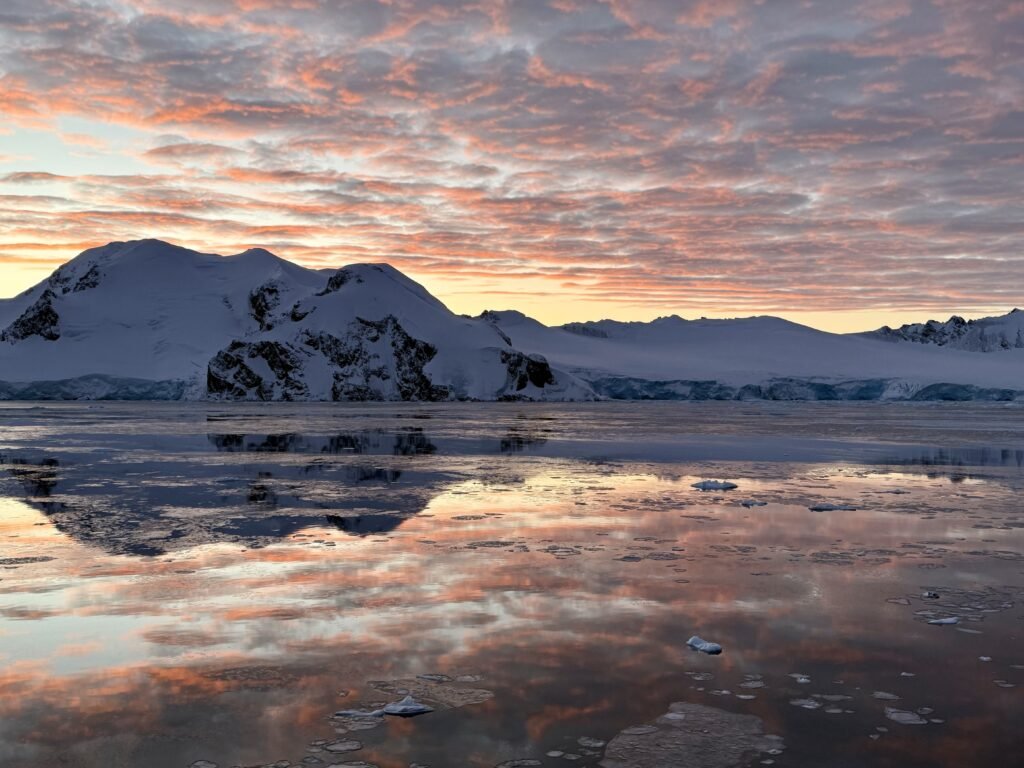
The Scenery in which we’re working. Photo by Mike Meredith
Science on the British Antarctic Survey’s research vessel RRS Sir David Attenborough cruise SD050 has now entered full swing, with sequences of oceanographic measurements close to the Sheldon Glacier near Rothera, near Blaiklock Island, and adjacent to the Horton and Hurley Glaciers. This cruise is a rare wintertime expedition with the ship, and affords us an excellent opportunity to further our understanding of how glaciers impact the ocean, and vice versa. It contributes to a number of scientific projects, including serving as a precursor the main POLOMINTS fieldwork that starts next season.
During our transit south to Rothera, we took the opportunity to make measurements in some important field sites along the way, including Börgen Bay on Anvers Island. This was the location where we witnessed a major glacier calving event some years ago, with bursts of rapid and intense ocean mixing as a result – the occurrence that led to the POLOMINTS project. We were surprised to again witness a calving event in Börgen Bay, albeit a smaller one, since such calvings are much more frequent in summer. We’ll be examining the data we collected there closely to look for the impacts on the ocean, and to better understand the seasonal differences in such effects.
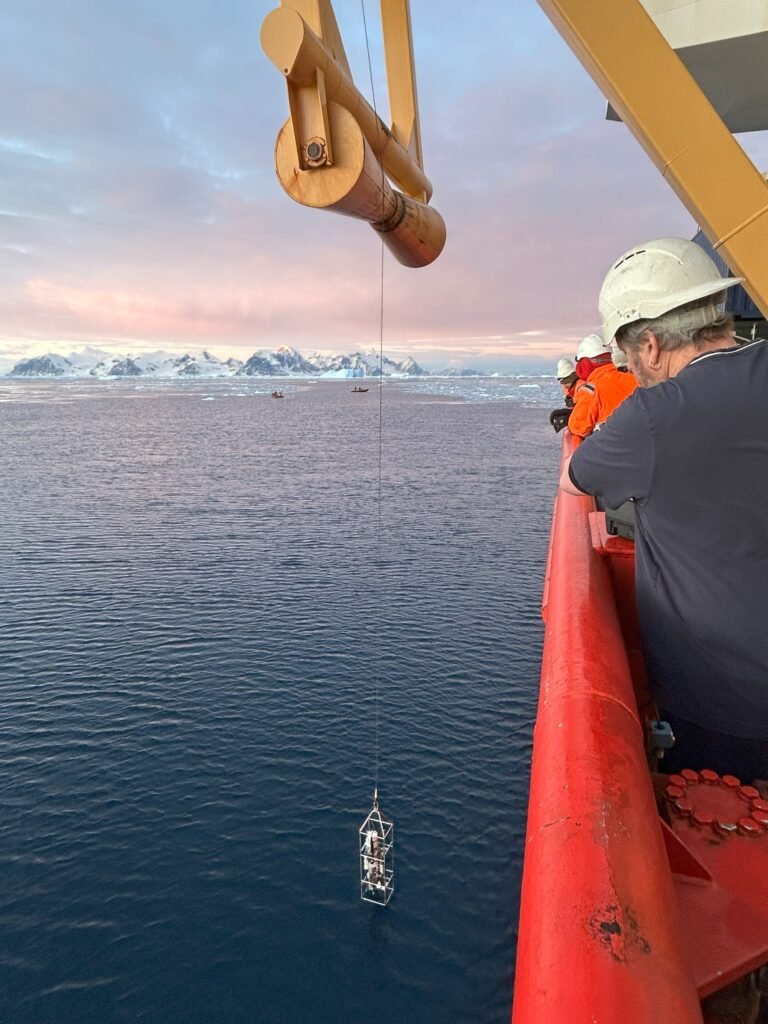
CDT Deployment. Photo by Mike Meredith
One of the main instruments we are using on this cruise is a Conductivity-Temperature-Depth (CTD) system, which is lowered from the ship to near the seabed, and which provides us with vertical profiles of key ocean variables that we’re interested in: temperature, salinity, chlorophyll concentration, and so on. We’re also collecting water samples for analysis in the ship’s laboratories, with some being saved for analysis back in the UK, and additionally will be collecting sediment samples. Taken together, these data and samples will help progress our understanding of how glacier melt and calving affects the ocean, and how nutrients fuel the growth of life in the sea. Ultimately, the science will contribute to our understanding of how the ocean around Antarctica impacts climate and the ecosystem, with the wintertime nature of these data will making them especially valuable.
We are most grateful to the outstanding work of the officers and crew of RRS Sir David Attenborough for supporting this science !
Cruise SD050 includes some pre-cursor science to the major POLOMINTS field programme that starts in January 2026. ITV News are reporting from SD050, including with POLOMINTS scientists.
RRS Sir David Attenborough winter cruise SD050 is currently on transit south toward Rothera and Ryder Bay, which will be our main POLOMINTS field site next summer season. During our transit, we called into Börgen Bay on Anvers Island, to take advantage of the opportunity to collect some water samples and underway ocean measurements. This is an especially interesting location for us, being where we witnessed the major glacier calving event some years ago that led to our discovery of calving-induced internal tsunamis, and the POLOMINTS project overall.
We studied the glacier in Börgen Bay for several hours while collecting measurements, during which we witnessed a significant calving event. This was surprising and fortuitous, since glacier calving is typically much more frequent in summer. We continue to learn and build up our understanding of these important dramatic events!